






The Soaring Demand for Data
The core claim that carbon emissions from data centers have tripled since 2018 is supported by recent studies tracking the industry's explosive growth. A November 2024 analysis found that US data centers produced 105 million tons of CO2 equivalent emissions in the past
year, a threefold increase from 2018 estimates. Another study focusing on the largest 'hyperscale' facilities noted their emissions were two to three times higher than a 2018 estimate. This dramatic rise isn't just a number; it reflects a fundamental shift in our digital habits. The electricity consumption of these facilities has surged, with total usage climbing from 108 terawatt-hours (TWh) in 2020 to 183 TWh in 2024 in the US alone. In 2024, data centers accounted for about 4.7% of total US electricity consumption, a figure that has experts concerned. Projections show this trend accelerating, not slowing down.
The Rise of Artificial Intelligence
The single biggest driver behind this energy surge is the explosion in artificial intelligence. Training and running large language models (LLMs) like those behind ChatGPT and other generative AI tools are incredibly computationally intensive. A single AI query can use nearly ten times more electricity than a simple Google search. These complex workloads require powerful, specialized computer chips that consume vast amounts of power and generate immense heat, which in turn requires constant, energy-draining cooling. The International Energy Agency (IEA) has warned that the global expansion of AI will account for three-quarters of the growth in data center electricity demand through 2030. The annual global shipment of AI servers has reportedly climbed eighteen-fold since 2020, illustrating the scale of this new demand.
A Green Paradox for Big Tech
This escalating energy use presents a major challenge for a tech industry that has publicly committed to sustainability. Companies like Google, Amazon, and Microsoft are among the world's largest corporate buyers of renewable energy. However, the explosive growth in demand is outstripping the pace of their green energy procurement and efficiency gains. The result is a green paradox: even as companies invest billions in renewables, their overall consumption is forcing a greater reliance on fossil fuels. A recent Harvard study found that over half of the electricity powering US hyperscale data centers came from fossil fuels, mainly natural gas and coal. The IEA projects that by 2030, natural gas could supply about 60% of the electricity used by US data centers as developers rush to find reliable power sources to bring new capacity online quickly.
The Path Forward: Efficiency and Innovation
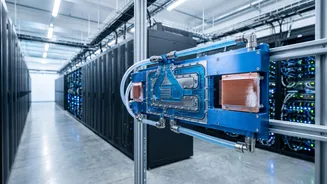
Addressing this challenge requires a multi-pronged approach. The industry is actively pursuing greater efficiency through improved data center design and operations. Metrics like Power Usage Effectiveness (PUE) are standard, but the focus is shifting to more advanced solutions. These include innovations in liquid cooling, which is more efficient than traditional air cooling, developing more energy-efficient chips, and strategically locating data centers in colder climates to reduce cooling costs. At the same time, there is a push for regulatory frameworks to manage this growth. Some regions in Europe are already mandating energy performance reporting and linking grid access to renewable energy use. In the long term, the tech industry is looking toward next-generation power sources, including nuclear fusion, to provide the clean, constant power these critical facilities demand.