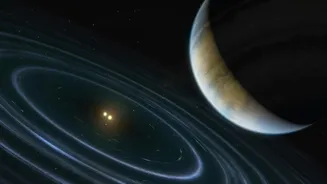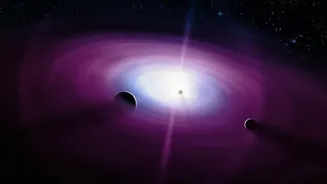


For centuries, we’ve viewed the cosmos as a predictable, clockwork machine. But new research on giant planets suggests their orbital dance is far more chaotic and unstable than previously imagined, rewriting our understanding of how solar systems evolve.
The Old View: A Clockwork Universe
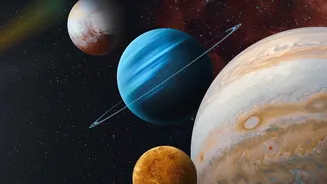
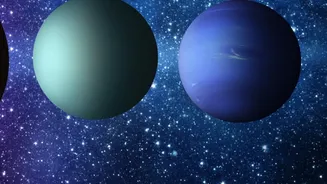
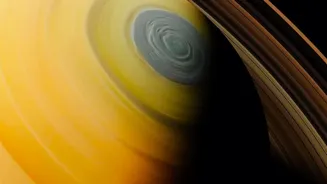
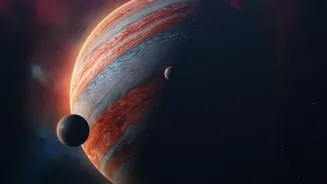
Since the days of Newton and Laplace, the prevailing view of our solar system has been one of remarkable stability. The giant planets—Jupiter, Saturn, Uranus, and Neptune—were thought to follow predictable paths, their immense gravity holding everything in a delicate but enduring balance. This idea, known as the clockwork universe, suggested that planetary systems, once formed, would remain largely unchanged for billions of years. Early models even struggled to explain certain anomalies, like the orbits of 'hot Jupiters' found in other systems, but the core assumption remained: giant planets settle into stable, long-term orbits. This belief was foundational to theories of planet formation, which suggested that planets form and largely stay in fixed, well-behaved paths.
Enter the N-Body Problem
The challenge with predicting planetary orbits is the sheer complexity of their gravitational interactions. While the pull between two bodies (like the Sun and Jupiter) is simple to calculate, adding a third body turns the situation into a famously difficult 'N-body problem'. With multiple planets all tugging on each other, their orbits can become chaotic over long timescales. A tiny change in a planet's initial position could lead to dramatically different outcomes millions of years later. Recent studies have leaned into this complexity, using powerful computers to run what are known as N-body simulations. These models track the gravitational forces between many digital 'particles' or planets over billions of years, revealing patterns that are impossible to predict with simple equations.
What the New Study Reveals
A new generation of planetary stability studies, leveraging these advanced simulations, is challenging the old clockwork model. Research has shown that a significant fraction of planetary systems with giant planets may not be stable at all. Instead of remaining in calm orbits, these massive worlds can chaotically interact, leading to dramatic outcomes. One study found that in many simulated systems, giant planets can kick their smaller neighbors out of orbit or even get ejected from the solar system entirely. These simulations suggest that seemingly stable systems can suddenly become unstable due to the complex gravitational interplay between the giants, sometimes triggered by interactions with an outer disk of smaller bodies, known as a planetesimal disk. This means that the peaceful-looking solar systems we observe today might be the survivors of a much more violent and chaotic past.
Is Our Solar System at Risk?
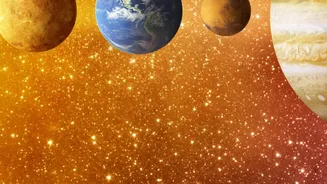
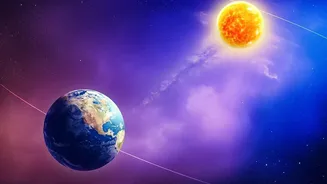
These findings naturally raise a question: could our own solar system be unstable? The short answer is, we are likely safe. While our solar system is technically chaotic, meaning we can't predict the exact position of Earth millions of years from now, its overall architecture is considered stable for the next few billion years. Studies by astronomers like Jacques Laskar have shown there is only a tiny, roughly 1% chance of a collision between the inner planets, such as Mercury and Venus, before the Sun dies. The giant outer planets in our system are in particularly stable configurations. The new research doesn't suggest Jupiter is about to fly off into deep space, but it refines our understanding of why our system is so stable, suggesting it might be a somewhat rare configuration among the countless possibilities in the galaxy.
Why This Matters for Finding Alien Life
This shift in understanding has major implications for the search for life beyond Earth. Many systems have giant planets, and their stability directly impacts the potential for habitable, Earth-like worlds. If a gas giant's orbit is unstable, it can easily disrupt the orbit of a smaller, rocky planet in the habitable zone, where liquid water could exist. A planet's orbit could be stretched into a wild ellipse, causing extreme climate swings, or the planet could be ejected from the system entirely. Therefore, identifying stable systems with well-behaved giant planets is now a critical filter in the search for extraterrestrial life. This research serves as a warning: just because a planet is in the habitable zone doesn't mean it's a safe place to call home.