

Propulsion Without Propellant
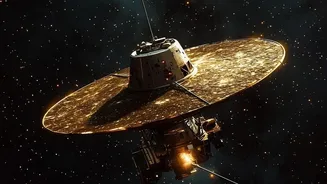
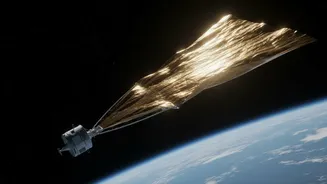
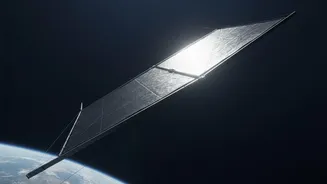
A solar sail is a form of spacecraft propulsion that operates on a remarkably simple, yet profound, principle. Instead of relying on heavy, finite chemical propellants like traditional rockets, a solar sail uses the constant pressure of sunlight itself.
Light, in the form of photons, has no mass but it does possess momentum. When countless photons from the Sun strike a large, reflective sail, they transfer their momentum, giving the spacecraft a gentle but continuous push. While this push is incredibly slight at any given moment, in the frictionless vacuum of space, it adds up. Over time, a solar sail-powered craft can achieve speeds that would be practically impossible for conventional rockets, which are limited by the amount of fuel they can carry.
The Physics of Light
To understand how this works, think of the sunlight hitting the sail as being similar to wind filling a boat's sail on Earth. As photons bounce off the sail's mirror-like surface, they impart a tiny force. To maximize this effect, solar sails must be both enormous and incredibly lightweight. The force is so small—for example, the total force on an 800-by-800-meter sail at Earth's distance from the Sun is only about 5 newtons, the force of a single pound—that a high area-to-mass ratio is critical. By angling the sail relative to the Sun, operators can steer the spacecraft, much like a sailor tacking into the wind. This allows the craft not only to move away from the Sun but also to change its orbit or even spiral inwards.
Engineering Gossamer Giants
The primary engineering challenge lies in creating sails that are vast but almost weightless. These are not rigid structures but are made of ultra-thin, reflective materials like aluminized Mylar or polyimide, which can be thinner than a human hair. Some materials are just a few microns thick, while researchers are exploring future sails made of graphene that would be just one atom thick. Packing such a large, delicate structure into a small spacecraft and deploying it flawlessly in space is a major feat. The deployment often involves innovative, lightweight booms that unfurl from the central spacecraft, pulling the sail material taut like a kite.
Unfurling in the Void
Recent missions have proven the viability of this technology. The Planetary Society's LightSail 2, launched in 2019, successfully used its 32-square-meter sail to change its orbit around Earth, demonstrating controlled solar sailing for the first time by a small satellite. More recently, NASA's Advanced Composite Solar Sail System (ACS3) has been testing new deployment technologies. Launched in April 2024, ACS3 is testing novel composite booms made of carbon fiber, which are lighter and stiffer than previous designs. In late 2024, the mission successfully deployed its 80-square-meter sail, providing valuable data for designing even larger and more efficient sails for future missions, despite encountering a slight bend in one boom that engineers continue to analyze.
A Future Without Fuel
The promise of solar sailing is a new class of long-duration, low-cost missions that are currently impractical. Without the need to carry fuel, spacecraft can be smaller, lighter, and dedicate more mass to scientific instruments. This technology could enable new types of missions, such as placing space weather warning satellites closer to the sun for earlier storm alerts, sending probes to survey near-Earth asteroids, or establishing communications relays for crewed missions to Mars. Ultimately, solar sailing is one of the few existing technologies that could one day enable interstellar travel, pushing a spacecraft to a fraction of the speed of light on a journey to another star system.