




A Glimpse into the Future
Astronomers have found a cosmic time machine of sorts, not one that looks back, but one that peers billions of years into our own future. Using NASA's James Webb Space Telescope, scientists have been studying a bizarre planetary system about 80 light-years
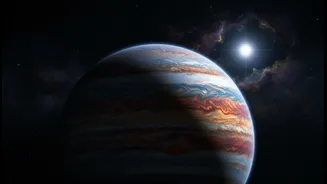
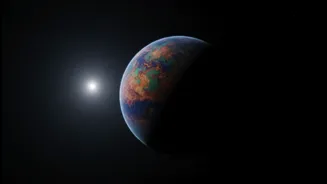
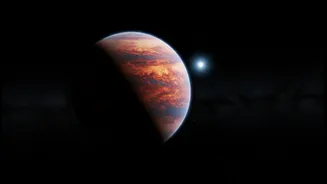
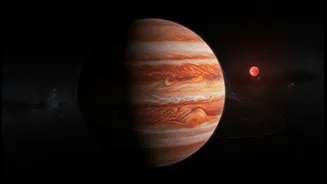
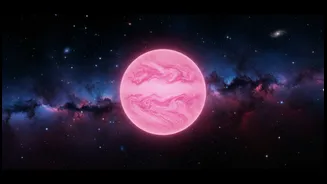
from Earth. At its center is a white dwarf—the tiny, super-dense corpse of a star that was once like our Sun. Orbiting this dead star is a giant planet, WD 1856 b, which is roughly the size of Jupiter but circles a star only the size of Earth. This strange duo is providing an unprecedented glimpse into what might happen to the giant planets in our own solar system after our Sun burns out.
The Life and Death of a Star
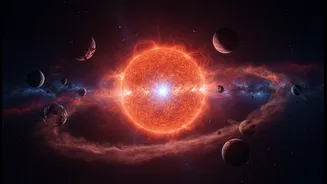
In about five billion years, our Sun will exhaust the hydrogen fuel in its core. It will then swell into a red giant, expanding more than 100 times its current size. This catastrophic phase will spell doom for the inner planets; Mercury and Venus will be vaporized, and Earth's fate hangs in the balance, though it will almost certainly be scorched beyond recognition. After this violent expansion, the Sun will shed its outer layers, leaving behind a white dwarf. Until recently, the fate of the outer planets like Jupiter and Saturn in this post-apocalyptic scenario was a matter of theoretical debate. They would survive the initial red giant phase, but their subsequent evolution was a mystery.
A Survivor's Strange Tale
The planet WD 1856 b presents a puzzle. It orbits its dead star every 34 hours, a distance 50 times closer than Earth is to our Sun. If it had always been in that position, it would have been destroyed when its star became a red giant. The new research provides a compelling answer: the planet survived the star’s death from a much safer, wider orbit. Then, billions of years later, it migrated inward. Scientists deduced this by measuring the planet's temperature. It is significantly warmer than can be explained by the dim light of the white dwarf alone. This residual heat is a leftover from its inward journey, as the white dwarf's immense gravity squeezed and heated the planet as it drew closer. This process, known as tidal heating, effectively 're-heated' the planet long after its star had died.
Our Solar System's Second Act
This discovery has profound implications for our own cosmic neighbourhood. It suggests that planetary systems don't just die when their star does; they can have a long, dynamic 'afterlife'. The survival and subsequent migration of WD 1856 b confirms that gas giants like Jupiter and Saturn will almost certainly survive the Sun’s death. Once the Sun becomes a white dwarf, having lost about half its mass, its gravitational pull will weaken. This will cause the surviving planets, including Jupiter, to drift into wider orbits. The system will become less stable, and over billions of years, gravitational nudges from other planets could send Jupiter or Saturn on a new journey, potentially migrating closer to the dying Sun, just as WD 1856 b did. This research is the first time we have been able to look forward and model what might happen to the outer planets in a post-Sun solar system.