




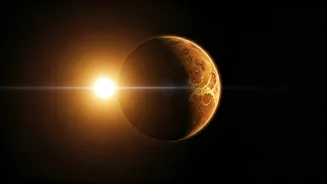


The Universe’s Ultimate Heavyweights
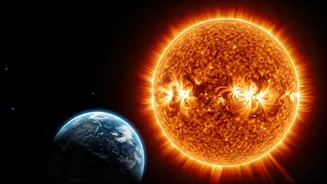
Before we get to the speed, let's talk about what a neutron star actually is. Think of it as a star's ghost. When a massive star, much bigger than our sun, runs out of fuel, it collapses under its own immense gravity and then explodes in a spectacular
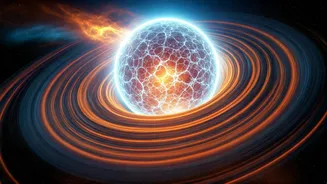
event called a supernova. While the outer layers are blasted into space, the star's core implodes with such force that protons and electrons are squeezed together to form neutrons. What’s left is an object of almost unimaginable density. A typical neutron star is only about 12 miles across—roughly the size of Manhattan—but it packs up to twice the mass of our entire sun. A single teaspoon of neutron star material would weigh about ten million tons on Earth. They are the densest objects in the known universe, second only to black holes.
Putting the “Mind Boggling” in Perspective
So, how fast is “mind-bogglingly fast”? The fastest-spinning neutron star ever observed, designated PSR J1748-2446ad, rotates at a dizzying 716 times per second. To put that in perspective, the blades in a high-end kitchen blender spin around 300 to 500 times per second. This city-sized object, heavier than the sun, is rotating so quickly that the surface at its equator is moving at nearly a quarter of the speed of light. If our own planet spun that fast, a day would last just over two minutes. The centrifugal force is so extreme that it's a constant battle against the star's own crushing gravity, which is the only thing preventing it from flying apart. These hyper-fast objects are known as “millisecond pulsars” because their rotation period is measured in milliseconds.
Why the Extreme Spin?
Neutron stars aren’t born spinning this quickly. Their incredible speed is a result of one of the fundamental laws of physics: the conservation of angular momentum. It's the same principle you see when an ice skater pulls their arms in to spin faster. The original, massive star might have been rotating very slowly, perhaps once every few weeks. But as its core collapsed from hundreds of thousands of miles across down to just a dozen miles, its rotational speed increased exponentially. Think of it as all that rotational energy being concentrated into a tiny, dense package. Some neutron stars get an extra speed boost later in life. If they are part of a binary system with another star, they can siphon material from their companion. As this material falls onto the neutron star, it acts like a jet, spinning the star up to even more incredible speeds.
Cosmic Lighthouses in the Dark
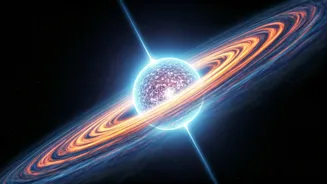
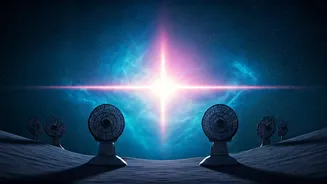
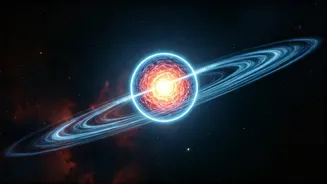
We can’t “see” a neutron star in the way we see our sun. They are far too small and distant. Instead, astronomers “capture” them by detecting the powerful beams of radiation they emit from their magnetic poles. As the neutron star spins, these beams sweep across space like the beam from a lighthouse. If one of these beams happens to flash across Earth, our radio telescopes detect a regular, repeating pulse—hence the name “pulsar.” Each pulse corresponds to one full rotation of the star. By timing these pulses with incredible precision, astronomers can calculate the star's spin rate. Telescopes like the Very Large Array (VLA) in New Mexico, the Chandra X-ray Observatory, and China’s FAST telescope are crucial tools for finding and studying these extreme objects, using their signals to test the laws of physics under conditions impossible to replicate on Earth.