



The Invisible Climate Threat
Methane (CH4) is the main component of natural gas and a potent greenhouse gas. Over a 20-year period, it is more than 80 times more effective at trapping heat in the atmosphere than carbon dioxide. Leaks from the vast global network of pipelines, processing
plants, and storage facilities contribute significantly to climate change, responsible for up to 30% of current global warming. Beyond the environmental damage, these leaks represent a staggering economic loss for the energy industry, estimated at billions of dollars annually in wasted product. Historically, detecting these leaks across thousands of kilometres of infrastructure, often in remote areas, has been a slow, expensive, and inefficient process relying on ground crews and less precise sensors.
Seeing the Unseen Spectrum
The game-changer is a technology called hyperspectral remote sensing. While a standard camera sees light in three basic bands (red, green, and blue), a hyperspectral imager captures data across hundreds of narrow spectral bands, extending far beyond what the human eye can see and into the infrared spectrum. Different materials and chemical compounds absorb and reflect light in unique ways, creating a distinct 'spectral fingerprint'. Methane has a specific absorption fingerprint in the short-wave infrared (SWIR) range of the light spectrum. Hyperspectral sensors, mounted on satellites or aircraft, are specifically designed to spot this unique signature. As sunlight passes through the atmosphere and reflects off the Earth, the sensors can detect the tell-tale sign of methane absorbing light, revealing an otherwise invisible plume.
How Satellites Pinpoint Leaks
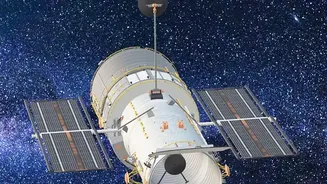
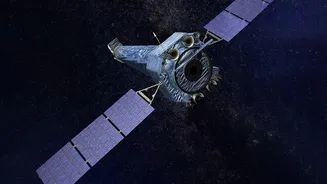
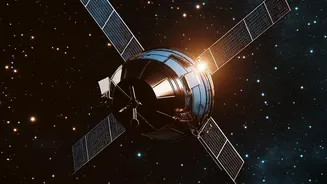
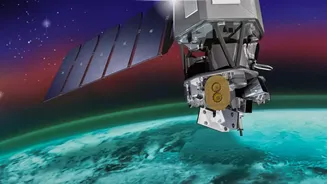
A new generation of satellites is now dedicated to this task. Missions like MethaneSAT, Carbon Mapper, and those from the European Space Agency are scanning vast regions of the Earth. These systems work in concert: some satellites perform wide-area scans to identify regions with high concentrations of methane, while others can zoom in on those 'hotspots' to pinpoint the exact source of a leak, sometimes down to a single piece of faulty equipment. By combining the hyperspectral data with powerful machine learning and AI algorithms, analysts can differentiate methane from other gases, calculate the volume and flow rate of the leak, and alert pipeline operators in near real-time to enable a swift response.
The Dual Benefit of Detection
The ability to quickly and accurately find these leaks provides a powerful dual benefit. For energy companies, plugging leaks means stopping the loss of a valuable commodity, improving operational efficiency, and enhancing safety. For the environment, it is one of the fastest and most cost-effective ways to slow the rate of global warming. More than 150 countries have pledged to cut methane emissions, and this technology provides the critical data needed to hold nations and corporations accountable. By making emissions visible and quantifiable, hyperspectral imaging transforms an abstract environmental goal into a concrete, actionable dataset that can drive policy and investment decisions.
A New Era for Infrastructure Management
Beyond directly spotting gas plumes, this technology is also being used to monitor the health of vegetation along pipeline routes. Chronic, low-level methane leaks from underground pipes can stress or kill plants, and these subtle changes in plant health are visible in hyperspectral data long before they can be seen on the ground. This provides another way to detect slow, hidden leaks that might otherwise go unnoticed for years. As India continues to expand its natural gas infrastructure, this type of advanced monitoring offers a path to build a more efficient, safer, and climate-friendly energy system from the start. The technology is no longer theoretical; it's a proven tool that is reshaping our ability to manage critical infrastructure and protect the planet.