



A Tiny But Formidable Foe
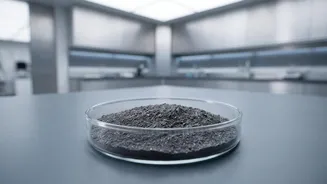
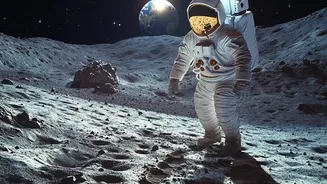
To understand the problem, you have to know that lunar dust, or regolith, is fundamentally different from what gathers on our shelves. For billions of years, the Moon’s surface has been bombarded by micrometeorites without wind or water to smooth the resulting
particles down. The result is a layer of fine, sharp, glass-like shards. During the Apollo missions, this abrasive material proved to be a serious nuisance. It scratched helmet visors, wore away at spacesuit boots, clogged mechanisms, and caused seals on sample containers to fail. Because the dust is also electrostatically charged by solar radiation, it clings stubbornly to every surface it touches, making it incredibly difficult to remove. Astronauts reported sneezing and nasal congestion, raising concerns about the long-term health effects of inhaling these sharp particles during extended missions.
The Landing Problem: Kicking Up Dust
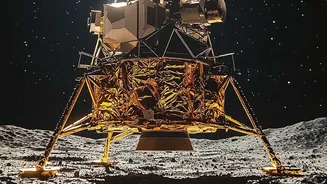
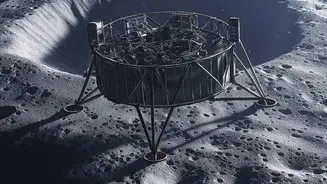
One of the most intense encounters with lunar dust happens during landing. The powerful engine plumes of a descending spacecraft can blast the loose regolith at incredible speeds, creating a blinding sheet of debris. This not only obscures a pilot's vision during the critical final moments of descent but also poses a threat to the lander itself and any nearby equipment. To better understand and predict these effects, NASA has recently been conducting a series of complex tests at its Langley Research Center. Inside a massive 60-foot spherical vacuum chamber, engineers are firing rocket plumes into a large bin of simulated lunar soil, called Black Point-1, which mimics the jagged, cohesive properties of actual moon dirt. By using high-speed cameras and sensors, they are gathering crucial data on how the dust cloud forms, how fast the particles travel, and how deep a crater is formed. This information is vital for designing safer landing systems for future Artemis missions.
An Electric Shield Against Dust
Once on the surface, keeping equipment and habitats clean is a top priority. Brushing the dust off often makes the problem worse due to its abrasive nature and static charge. One of the most promising technologies NASA is developing is the Electrodynamic Dust Shield (EDS). This system uses a network of transparent electrodes embedded in a material, which can be applied to everything from solar panels and camera lenses to spacesuit fabrics. By creating a shifting electric field, the EDS can actively repel and lift dust particles off a surface, essentially cleaning it with the flip of a switch. The technology has been tested on the International Space Station and, more recently, demonstrated its effectiveness on the Moon itself during Firefly Aerospace's Blue Ghost Mission 1 in early 2025. Images from the mission showed the EDS successfully clearing dust from its surfaces, marking a major milestone for future long-term operations on the Moon.
Measuring and Mitigating the Threat
While repelling dust is one part of the solution, another is simply measuring how much has accumulated. NASA has limited quantities of real Apollo moon dust, so most tests are done with simulators. A key challenge has been figuring out how to accurately quantify dust on complex surfaces like a spacesuit. Researchers at Johnson Space Center are adapting portable X-ray fluorescence (XRF) analyzers for this purpose. These devices, typically used in mining and metal sorting, can detect specific elements in the lunar dust, like titanium, that aren't present in the suit material. This allows engineers to create heatmaps showing dust concentration, giving them a clear picture of whether their cleaning methods are working. Other experiments, like the Regolith Adherence Characterization (RAC) instrument, are designed to expose different materials to the lunar environment to see which ones best resist dust buildup.