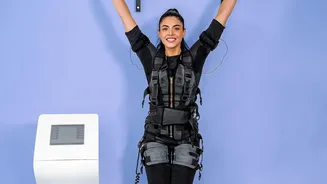








When fitness icon Shilpa Shetty shares a workout tip, people listen. Her latest social media clip goes beyond just demonstrating an exercise; it highlights two crucial, often-overlooked elements for a truly effective routine: timing and body control.
The Philosophy of Mindful Movement
For years, Shilpa Shetty has advocated for a holistic approach to wellness that integrates mind and body. Her philosophy, often summarized as 'Swasth Raho, Mast Raho' (Stay Healthy, Stay Happy), emphasizes that fitness is not merely about appearance but about feeling strong and balanced from within. This mindset is evident in her recent social media posts, where the focus shifts from simply completing a workout to perfecting how it is performed. In one recent clip, she demonstrated a no-hands floor-rise, noting, 'It's not just about getting up; it's how you get up that matters'. This focus on quality of movement is central to her message, encouraging followers to see exercise as a mindful practice rather than a chore. Her approach combines yoga, strength training, and cardio, always underscoring the importance of consistency over intensity.
Why Timing is More Than Speed
In the context of exercise, 'timing' isn't just about how fast you can go; it's about controlling the tempo of each repetition. This includes the concentric (muscle-shortening) phase, the eccentric (muscle-lengthening) phase, and any pauses in between. By deliberately slowing down movements, you increase the time your muscles are under tension, which can lead to greater strength gains and muscle development. Controlled, slower movements also force you to engage stabilizing muscles and maintain proper form, which is critical for preventing injuries. Rushing through exercises with momentum might feel like you're working harder, but it often sacrifices the very benefits you're trying to achieve. As Shilpa often demonstrates in her functional training routines, which include squats and lunges, the deliberate pace is what builds true strength and endurance.
Mastering Total Body Control
Body control, or proprioception, is your body's awareness of its position in space. It's the silent skill that allows you to perform complex movements with grace and stability. In a recent video, Shilpa showcased an exercise that challenged her coordination and balance by having her drop and catch two balls, first while standing and then while balancing on one leg. This kind of drill perfectly illustrates body control in action. It requires the brain and body to work in harmony, engaging the core and smaller stabilizing muscles to prevent falls and maintain posture. Improving body control not only makes your workouts safer and more effective but also translates directly into real-life functional strength, like getting up from the floor without assistance—a movement Shilpa recently highlighted as an indicator of lower-body strength, balance, and mobility.
How to Apply These Principles to Your Workout
You don't need to be a celebrity to train like one. Incorporating Shilpa's principles into your own routine is straightforward. Start by choosing one or two exercises in your next workout and focusing entirely on form. Try slowing down the movement—for example, take three seconds to lower into a squat and three seconds to rise. Pay attention to every part of your body. Are your core muscles engaged? Is your back straight? Are you stable? You can use a mirror to check your form or even record yourself. For body control, add balance challenges. Try holding a yoga pose for a few extra breaths or performing simple exercises like bicep curls while standing on one leg. The goal is to make every movement intentional. As fitness experts note, this mindful approach cultivates a stronger mind-body connection, which enhances performance and drastically reduces the risk of injury.