





What is the Tower-Catch Strategy?
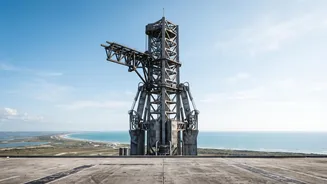
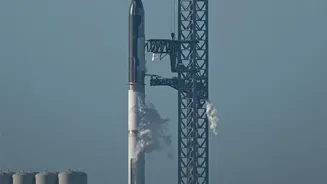
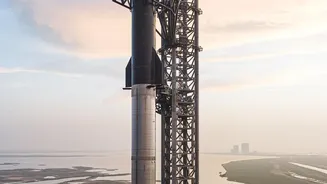
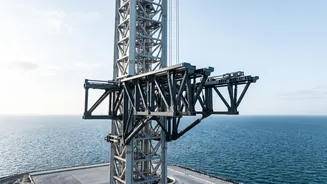
Instead of a gentle touchdown on landing legs, SpaceX’s plan for its massive Super Heavy booster involves it being caught in mid-air by the launch tower itself. Affectionately nicknamed 'Mechazilla', this system uses two huge, movable arms on the launch integration
tower to grab the returning booster just before it reaches the ground. The rocket descends towards the tower, slows to a near-hover using its Raptor engines, and allows the 'chopstick' arms to close around it, securing it by two small, reinforced points near the top of the booster. This method completely eliminates the need for traditional landing gear on the rocket.
The Old Way: Conventional Landings
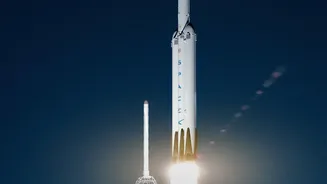
For years, the gold standard of reusable rockets has been SpaceX's own Falcon 9. After launching its payload, the Falcon 9's first stage performs a controlled descent, reignites its engines for a 'suicide burn', and lands vertically on four deployable legs. These landings can happen either back at the launch site or on an autonomous droneship positioned hundreds of kilometres out at sea. Before this, rockets were almost entirely expendable, with stages burning up on reentry or splashing into the ocean to be discarded. The Falcon 9 proved that vertical landing was not only possible but economically viable, paving the way for the even more ambitious Starship program.
Why Ditch the Landing Legs?
If landing legs work so well for the Falcon 9, why abandon them for Starship? The answer comes down to mass and speed. The Super Heavy booster is vastly larger and heavier than a Falcon 9. Designing landing legs strong enough to support its weight upon landing would add a significant amount of mass to the vehicle. Every kilogram of rocket is a kilogram that isn't payload or fuel. By removing the legs and moving that structural mass to the ground-based tower—which doesn't have to fly—SpaceX makes the booster more efficient, allowing it to lift heavier payloads. The tower's arms and support structure can be massively over-engineered for strength in a way that onboard landing legs never could be.
The Ultimate Goal: Rapid Reusability
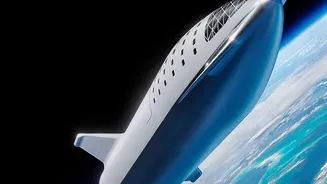
The tower-catch strategy is about much more than just saving weight; it's the cornerstone of SpaceX's plan for 'airline-like operations'. The company's goal is to make spaceflight as routine and frequent as air travel, a feat that requires extremely rapid turnaround times. Catching the booster directly on the launch mount means it can theoretically be inspected, refuelled, and stacked with a new Starship upper stage for another flight in a matter of hours, not days or weeks. This speed is critical for SpaceX's long-term ambitions, such as establishing a self-sustaining city on Mars. A trip to Mars would require a Starship to be refuelled in Earth's orbit by multiple 'tanker' Starships, necessitating a high launch cadence that would be impossible with slower recovery methods.
A High-Stakes Engineering Trade-Off
While the benefits are enormous, the tower-catch method is also incredibly complex and demanding. It requires pinpoint precision. The booster must navigate its return journey and final descent with extreme accuracy in terms of position, velocity, and timing for the arms to make a successful capture. The entire system—from the booster’s grid fins and engines to the tower’s hydraulic arms and tracking sensors—must work in perfect harmony. SpaceX is essentially trading mechanical complexity on the rocket for operational and software complexity on the ground. It's a high-risk, high-reward approach that, if perfected, could fundamentally change the economics of accessing space.