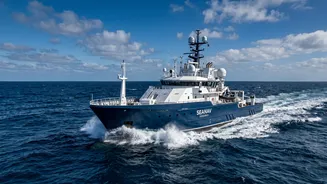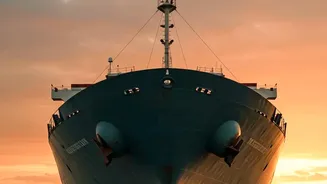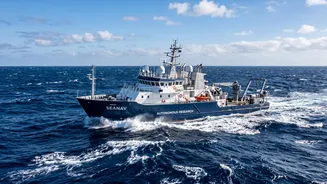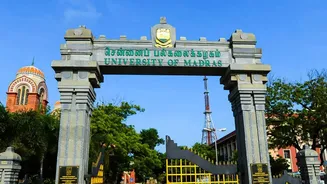



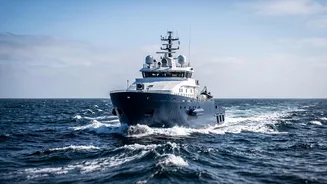
The idea of self-driving ships navigating the world’s oceans is moving from science fiction to reality, and IIT Madras is at the forefront. Its new SeaNav platform provides a crucial solution for testing this futuristic technology safely.
What is SeaNav?
SeaNav, short
for Sea Navigation, is a state-of-the-art digital twin platform developed by researchers in the Department of Ocean Engineering at IIT Madras. Think of it as an incredibly realistic video game for the maritime industry. It creates a high-fidelity virtual environment that can simulate everything from the movement of massive ships to changing ocean conditions and busy vessel traffic. This 'digital twin' technology allows developers to test, validate, and train autonomous navigation systems without ever putting a real ship at risk. The platform was built using the Unity3D engine, a powerful tool for creating interactive 3D content, and has been calibrated using data from a 320-meter-long tanker vessel to ensure its simulations closely mirror real-world operations.
The Challenge of Real-World Testing
Developing autonomous technology for vehicles on land is complex enough, but the ocean presents a unique and far more challenging environment. Real-world testing for self-driving ships is not only incredibly expensive and logistically complicated but also potentially hazardous. Any error in an algorithm could lead to catastrophic consequences, including collisions, oil spills, and damage to hugely expensive assets. The global shipping industry is the backbone of world trade, carrying over 80% of goods, so safety and reliability are paramount. SeaNav directly addresses this problem by providing a safe, controlled, and cost-effective sandbox where navigation algorithms can be pushed to their limits in countless scenarios before being deployed on the water.
How the Digital Twin Works
SeaNav combines several advanced technologies to create its immersive simulation. It uses artificial intelligence, advanced sensor fusion, and even virtual reality to build a comprehensive testing ground. This allows researchers and human operators to train in a variety of situations. The platform can replicate the physics of ocean waves, the specific movements of different ship types, and complex navigation environments. The work is part of a broader effort at IIT Madras, which has established a Centre of Excellence for Vessels and Unmanned Systems to become a global leader in marine autonomy. This centre focuses on interdisciplinary research across naval architecture, control theory, and AI to solve the challenges of deploying autonomous vessels.
A Boost for India's Maritime Vision
This innovation isn't just a technical achievement; it's a strategic one. The development of SeaNav aligns perfectly with the Government of India's 'Sagarmala Programme' and the 'Maritime India Vision 2030'. These ambitious initiatives aim to modernize India's ports and maritime sector by embracing digital technologies and automation. By developing this capability inhouse, India reduces its reliance on foreign technology and builds sovereign capacity in a critical sector. The platform is expected to strengthen safety at major Indian ports, including Chennai, Mumbai, Visakhapatnam, and Kochi, by helping develop AIassisted navigation systems that can reduce the risk of collisions and grounding.
The Future of Autonomous Shipping
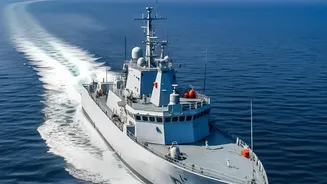
While fully autonomous ships operating without any crew are still on the horizon, the industry is moving through several stages of autonomy, from automated processes with crew onboard to fully remotecontrolled vessels. This shift promises significant benefits, including reduced operational costs, enhanced safety by minimizing human error, and greater fuel efficiency. Technologies like SeaNav are crucial enablers of this transition. Beyond commercial shipping, the platforms multiersessel simulation capabilities have significant potential for other applications, such as coordinating coastal surveillance missions, planning searchandrescue operations, and even in maritime defence scenarios.