

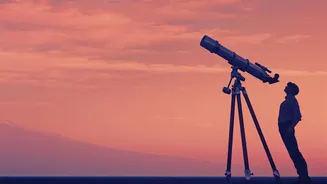
Escape the City Glow
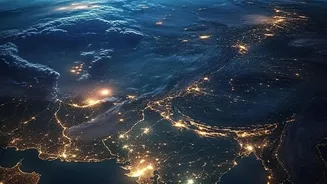
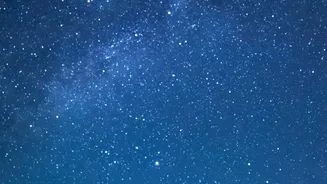
The single most important factor for good stargazing is a dark sky. The glow from cities and towns, known as light pollution, washes out all but the brightest stars and planets. It creates a bright background haze that makes it impossible to see fainter
objects like the Milky Way, nebulae, or meteor showers. For a truly breathtaking view, you need to get away from artificial lights. Even driving 30 to 40 kilometres outside a major city can make a dramatic difference. Websites and apps dedicated to mapping light pollution can help you find a 'dark sky' spot nearby, often in national parks or rural areas, where the cosmos can reveal its full glory.
Let Your Eyes Adapt
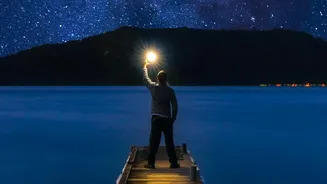
Once you've found your dark spot, your work isn't done. Your eyes need time to adjust to the darkness, a process called dark adaptation. It can take 20 to 30 minutes for your pupils to fully dilate and for the light-sensitive cells in your retina to reach their peak performance. During this time, you must avoid all sources of white light. That means no checking your phone, no turning on a regular flashlight, and no car headlights. Be patient; as your eyes adapt, you will notice more and more stars appearing, as if the sky is slowly coming into focus.
Use a Red Light
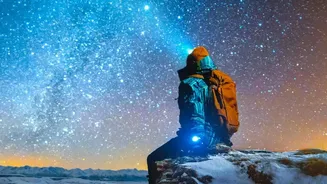
If you need to see your surroundings or consult a star chart, a red light is your best friend. Unlike white or blue light, red light has a longer wavelength that doesn't ruin your night vision. The light-sensitive rhodopsin in your eyes, which is crucial for seeing in the dark, is less affected by it. You can buy a dedicated red-light headlamp, or simply cover a regular flashlight with a piece of red cellophane or plastic. Many stargazing apps also feature a red-light mode to preserve your hard-won dark adaptation.
Know What You're Looking For
A sky full of stars is beautiful, but it's even more rewarding when you can identify what you're seeing. Modern technology makes this incredibly easy. There are numerous smartphone apps, such as SkyView, Star Walk 2, and Stellarium, that use your phone's GPS and compass to show you a real-time map of the sky. Simply point your device at a bright object, and the app will identify it, whether it's a planet like Jupiter, a constellation like Orion, or even the International Space Station flying overhead. For a more traditional approach, you can print a monthly star chart online to learn the layout of the constellations.
Check the Moon Phase
Besides clouds, the biggest natural source of light pollution is the Moon. A bright, full moon can wash out the sky almost as effectively as a city streetlamp, making it difficult to see fainter stars and meteor showers. For the best experience, plan your stargazing nights around the New Moon, when the sky is at its darkest. The days leading up to and following the New Moon are also excellent. You can easily check the lunar calendar online or within most weather and astronomy apps to find the optimal viewing times each month.
Try Binoculars, the Hidden Gem
While this guide is about avoiding a telescope, a simple pair of binoculars is a fantastic and affordable upgrade for any beginner. Binoculars are essentially two small telescopes mounted together, and they are perfect for exploring the Moon's craters, spotting the four largest moons of Jupiter, or getting a closer look at star clusters like the Pleiades. They gather more light than your naked eye, revealing details you would otherwise miss. A good starting size for astronomy is 7x50 or 10x50, where the first number is the magnification and the second is the diameter of the lenses in millimetres.
Get Comfortable and Be Patient
Stargazing is an activity of patience. You'll be spending a fair amount of time looking up, so comfort is key. Standing and craning your neck will quickly become uncomfortable. A reclining lounge chair or even just a thick blanket on the ground will make the experience far more enjoyable. Dress in warm layers, even on a summer night, as temperatures can drop significantly after sunset. Bring a warm drink in a flask and settle in. The longer you look, the more you will see, from faint satellites tracing silent paths across the sky to the sudden, brilliant streak of a meteor.