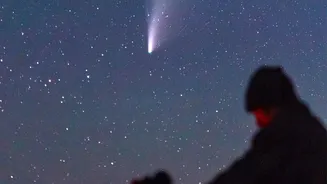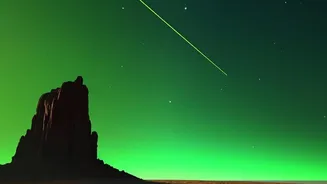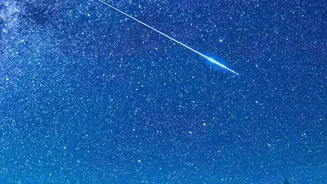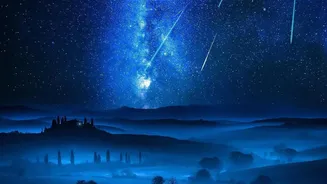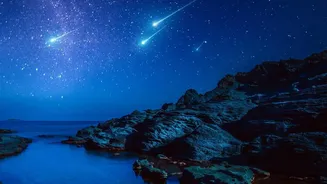






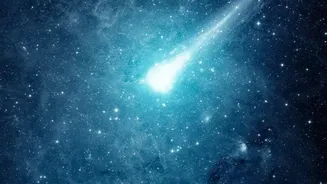


Every October, the night sky puts on a show. The Orionid meteor shower offers a dazzling display of shooting stars, but their origin story is even more incredible. These fleeting streaks of light are a direct message from the most famous comet of all.
The Ghost of a Famous Comet
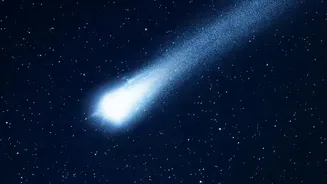
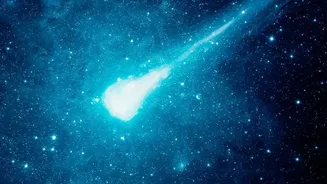
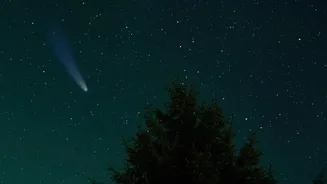
The story of the Orionid meteor shower begins with Comet 1P/Halley, a celestial celebrity that has captivated humanity for centuries. Halley's Comet is what's known as a 'dirty snowball'—a massive chunk of ice, dust, and rock. It follows a long, elliptical path around the sun, a journey that takes roughly 76 years to complete. We last saw it from Earth in 1986, and it won't be back for a visit until 2061. But even though the comet itself is now far away in the distant solar system, it leaves a powerful legacy behind. Twice a year, Earth gets a reminder of its passage, written in fire across the night sky.
A River of Rubble in Space
Each time Halley's Comet swings through the inner solar system and gets closer to the sun, the heat causes its surface to sublimate—turning solid ice directly into gas. This process blasts away dust, rock, and other small particles that were trapped in the ice. Over thousands of years and countless orbits, this has created a vast, sparse trail of debris that follows the comet's orbital path. Think of it as a 'river of rubble' floating in space. This debris doesn't just disappear; it continues to orbit the sun long after the comet has moved on. The particles, most no bigger than a grain of sand, are the direct source of the Orionids.
Earth's Annual Cosmic Collision
The meteor shower happens because Earth's own orbit around the sun intersects with this cometary debris trail. Every year in October, our planet plows through the cloud of particles left behind by Halley's Comet. When these tiny pieces of ancient comet dust slam into our upper atmosphere, they do so at an incredible speed—about 66 kilometres per second. At that velocity, friction with the air heats the particles to thousands of degrees, causing them to vaporize in a brilliant flash of light. That flash is what we see from the ground as a meteor, or 'shooting star'. So, every Orionid meteor you see is a tiny piece of Halley's Comet burning up high above our heads.
Why They Are Called the Orionids
The shower gets its name from the constellation Orion the Hunter. From our perspective on Earth, the meteors appear to originate from a single point in the sky, known as the radiant. For this particular shower, that radiant point is located near Orion's bright reddish star, Betelgeuse. While the meteors will streak across the entire sky, their trails will all seem to point back to Orion. This is simply a matter of perspective, much like how snowflakes seem to fly at you from a central point when you're driving through a snowstorm. The constellation isn't the source of the meteors, but it serves as a helpful signpost for skywatchers.
How to Watch the 2026 Show
The Orionid meteor shower is active from early October to early November each year. For 2026, the peak is predicted for the night of October 21-22. During the peak, you might see between 10 and 20 meteors per hour under ideal conditions. The main challenge for viewing in 2026 is a bright waxing gibbous moon, which will be out during the early part of the night. The best strategy is to wait until the moon sets, which happens a few hours before dawn. Find a dark location away from city lights, lie back, and let your eyes adjust for about 20-30 minutes. No special equipment is needed; the show is best enjoyed with just your eyes.