




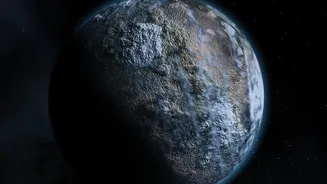


What is a Superhabitable World?
A superhabitable world is a hypothetical planet that could support a greater quantity and diversity of life than Earth. The concept, introduced in 2014 by astrobiologists René Heller and John Armstrong, challenges our Earth-centric view of habitability.
They argue that instead of looking for an exact copy of our planet, we should identify the key ingredients for life and then determine the planetary conditions that could optimize them. It’s not about finding a new home, but about broadening our understanding of where complex life might thrive in the universe. The core idea is that 'best' doesn't necessarily mean 'just like us'.
Bigger Could Be Better
One of the key traits of a superhabitable planet is that it would likely be slightly larger and more massive than Earth. A planet up to 1.5 times Earth's mass could be more advantageous for several reasons. Its stronger gravity would help it hold onto a thicker atmosphere for a longer period, providing a more stable climate and better protection from harmful cosmic rays. More mass also means more retained internal heat from its formation and from radioactive decay. This internal engine is crucial for driving plate tectonics, a process that helps regulate a planet's climate and recycle essential nutrients for life. A larger surface area, potentially with more shallow seas and archipelagos, could also lead to greater biodiversity, much like Earth's rainforests and coral reefs.
The Ideal Star and a Ripe Old Age
The type of star a planet orbits is critical. Our sun, a G-type star, has a lifespan of about 10 billion years. While that sounds long, it took nearly 4 billion years for complex life to appear on Earth. Scientists suggest that K-type dwarf stars, which are slightly cooler and less luminous than our sun, might be the ideal hosts. These 'orange dwarfs' have incredibly long and stable lifespans, lasting anywhere from 20 to 70 billion years. This provides a much longer, more stable window for life to emerge and evolve into complex forms. Consequently, the ideal age for a superhabitable planet is thought to be between 5 and 8 billion years old—a bit older than our 4.5-billion-year-old Earth, giving it more time to have developed a rich biosphere.
A Warmer, Wetter Climate
While we worry about global warming on Earth, a planet that is naturally slightly warmer and wetter could be a paradise for life. Researchers propose that a mean surface temperature about 5 degrees Celsius higher than Earth's would be ideal. This warmth, combined with higher humidity and more cloud cover, could fuel larger and more productive biomes, similar to how Earth's tropical rainforests are bursting with biodiversity despite covering a small fraction of the planet's surface. The key is having more available water distributed across the planet, potentially in the form of widespread shallow seas rather than vast, deep oceans, creating more coastline habitats where life often flourishes.
Are There Any Candidates Out There?
This all sounds great in theory, but do any such planets exist? In 2020, a team of scientists led by Dirk Schulze-Makuch identified 24 potential superhabitable candidates from the more than 4,500 exoplanets known at the time. These worlds, all more than 100 light-years away, fit some of the key criteria: they orbit within their star's habitable zone and have promising sizes and ages. However, it's crucial to note that these are just 'candidates'. Much of the data is unconfirmed, and key details like atmospheric composition and the presence of water are still unknown. These planets serve as a priority list for powerful new instruments like the James Webb Space Telescope, which can begin to probe their atmospheres and tell us if they are truly more suitable for life than our own world.