





Our Planet's Invisible Shield
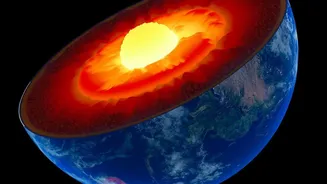
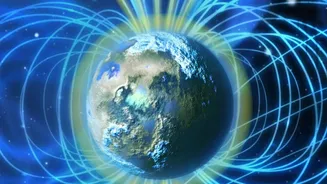
Deep within our planet, the churning of a molten iron and nickel outer core acts like a colossal dynamo. This motion generates powerful electric currents, which in turn create the vast magnetic field that extends tens of thousands of kilometres into space.
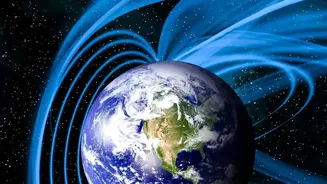
This bubble, known as the magnetosphere, is our planet's first line of defence. It’s an invisible but essential piece of planetary infrastructure, a shield that deflects the most dangerous assaults from our own sun and the wider cosmos.
The Sun’s Constant Barrage
The Sun, while the source of life-giving light and heat, also continuously bombards the solar system with a stream of charged particles called the solar wind. These particles race outwards at hundreds of kilometres per second. Occasionally, the Sun unleashes even more powerful bursts, known as coronal mass ejections. Without a protective shield, this constant barrage can have devastating effects. It can strip away a planet's atmosphere over millions of years, leaving it barren and exposed. Furthermore, this solar wind and high-energy cosmic rays from deep space are forms of radiation that can be lethal to life.
How the Shield Protects Life
When the solar wind hits Earth’s magnetosphere, the vast majority of its charged particles are deflected. The magnetic field acts as a barrier, forcing the particles to flow around our planet. This prevents the solar wind from eroding our atmosphere and boiling away our oceans, which is what scientists believe happened to Mars after it lost its magnetic field billions of years ago. The field also protects life on the surface from a constant shower of harmful radiation that can damage DNA, cause mutations, and make the evolution of complex, multicellular organisms nearly impossible. Some particles get trapped and are funnelled towards the poles, where they collide with atmospheric gases to create the spectacular auroras—a beautiful reminder of the shield at work.
A Complex Relationship with Evolution
While a strong magnetic field is clearly crucial for maintaining a habitable planet today, some recent research suggests a more nuanced story. Scientists have found evidence that the evolution of the first large, complex animals during the Ediacaran Period coincided with a time when the Earth's magnetic field was exceptionally weak—perhaps 30 times weaker than it is today. One theory proposes that this ultra-weak field allowed more hydrogen to escape from the atmosphere into space. This process could have led to a gradual increase in the concentration of oxygen in the atmosphere and oceans, providing the fuel needed for these larger, more mobile life forms to evolve and diversify. This suggests that while a strong field is needed for long-term stability, periods of weakness may have created unique environmental pressures that spurred evolutionary leaps.
The Martian Cautionary Tale
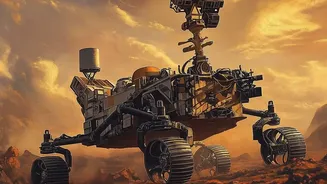
To understand the importance of our magnetic field, we only need to look at our neighbour, Mars. Evidence strongly suggests that Mars once had liquid water, a thicker atmosphere, and a protective magnetic field. Around four billion years ago, however, its internal dynamo shut down, and the magnetic field vanished. Without this shield, the solar wind began to strip away the Martian atmosphere, particle by particle. Over time, the planet grew cold and dry. The water evaporated or froze, and the surface became the irradiated, inhospitable desert we see today. Mars serves as a stark reminder of what can happen to a planet that loses its invisible guardian.