
A Visitor from Another Star
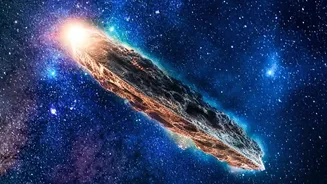
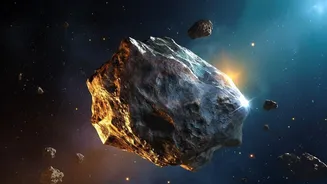
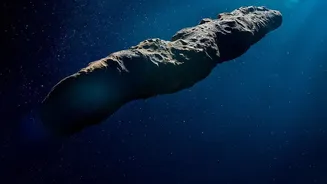
At its core, 3I/ATLAS is an interstellar object, as denoted by the "I" in its official name. It is the third such visitor ever confirmed, following 1I/'Oumuamua and 2I/Borisov. Unlike every planet and asteroid bound to our Sun, 3I/ATLAS is just passing
through. Scientists know this from its trajectory, a distinct path known as a hyperbolic orbit. Objects from our solar system travel in closed ellipses. Interstellar visitors, however, approach the Sun, get a gravitational slingshot, and then head back into the galaxy, never to return. Its incredible speed is another giveaway; it's moving too fast for the Sun's gravity to capture it.
How Was It Found?
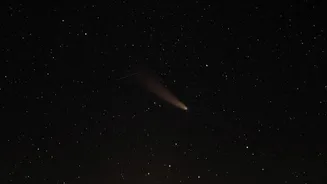
The discovery was made by the Asteroid Terrestrial-impact Last Alert System (ATLAS), a robotic survey that scans the sky for moving objects. Initially just a faint dot, astronomers tracked its path over several nights. When they calculated its orbit, they realised it wasn’t a closed loop but an open-ended, hyperbolic path—the tell-tale sign of an interstellar origin. The announcement quickly mobilised observatories around the world to turn their gaze toward this fleeting guest before it travels too far away to be seen.
What Is It Made Of?
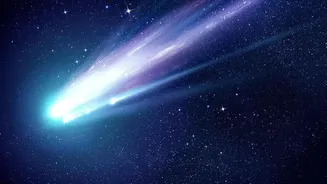
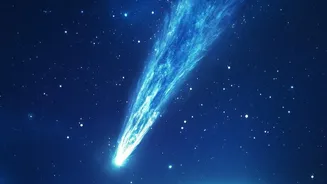
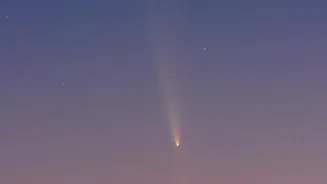
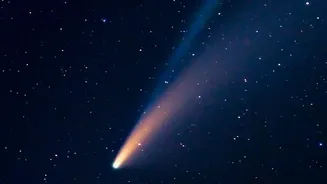
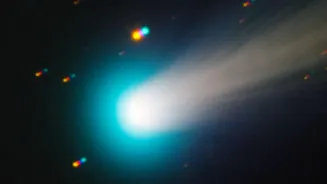
Determining its composition requires powerful tools, primarily spectroscopy, which analyses the light reflecting off the object. This reflected light acts like a chemical fingerprint, revealing the elements present. Early observations suggest that, unlike the rocky 'Oumuamua, 3I/ATLAS may be an icy body similar to comet 2I/Borisov. As it nears the Sun, heat could cause these ices to vaporise, creating a temporary atmosphere, or coma. This would offer even more clues about the distant star system it came from, giving scientists a direct look at the chemistry of another corner of our galaxy.
The Global Race to Observe
The discovery triggered a coordinated, worldwide race against time. The window for detailed study is only a few months long before 3I/ATLAS disappears into deep space. Major ground-based telescopes in Chile and Hawaii are tracking its brightness and rotation, while space telescopes like Hubble and the James Webb Space Telescope (JWST) are being pointed at it. The JWST, with its powerful infrared vision, is perfectly suited to study the heat and chemical makeup of any gas and dust escaping its surface. Every piece of data is a vital clue in this scientific detective story.
Why This Cosmic Messenger Matters
Interstellar objects are invaluable scientific treasures. Our solar system formed from a specific cloud of gas and dust, giving our local objects a shared heritage. 3I/ATLAS, however, is a physical sample from a different stellar neighbourhood. Studying it is like performing remote geology on a world light-years away. Its composition can tell us about the chemical building blocks of planets around other stars—whether it contains water ice, organic molecules, or exotic minerals. Each visitor helps us understand how planetary systems form and evolve across the universe.