




An Accidental Discovery
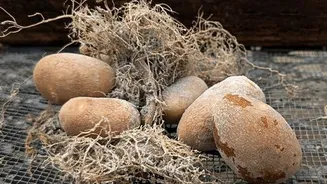
The story begins with a stroke of luck in the Gediz Vallis channel of Gale Crater. In May 2024, the Curiosity rover accidentally drove over a seemingly unremarkable rock, cracking it open. What it revealed inside was astonishing: pale-yellow crystals.
Scientists on Earth were stunned. While Mars is known to be rich in sulphur, it has almost always been found in the form of sulfates—minerals where sulphur is bonded with oxygen and other elements, often left behind by evaporating water. This was different. Analysis confirmed it was elemental sulphur, meaning sulphur in its pure form, a first for Mars. The find was described by one project scientist as the 'strangest find of the whole mission'.
A Puzzle in the Dust
A single strange rock might be a fluke, perhaps transported from elsewhere. But Curiosity soon revealed this was no isolated incident. The rover found an entire field of these fragile, pure sulphur rocks scattered across an area of about 2,100 square meters. This suggested the rocks likely formed right where they were found. On Earth, pure sulphur is often associated with specific environments like volcanic vents or the activity of microbes, neither of which were obvious at this location. This left scientists with a compelling puzzle: how did so much pure sulphur form in this part of Mars billions of years ago?
Clues in the Chemistry
The headline-making discovery is part of a broader investigation into Martian sulphur. The element and its various forms, or isotopes, are crucial for understanding a planet's history. The composition of sulphur can reveal details about past atmospheric conditions, volcanic activity, and even the potential for life. On Mars, the story told by sulphur is proving to be far more intricate than on Earth. Studies of samples collected by Curiosity show a massive variation in sulphur isotopes, a range similar to that found in diverse terrestrial environments. This wide range points to a dynamic past, where different processes were shaping the Martian surface chemistry.
Theories of Formation
To explain the surprising field of pure sulphur, scientists have put forward a few compelling ideas that do not require life. One leading theory, published in the journal 'Science' in June 2026, proposes that sulphur-bearing gases from ancient volcanic activity were trapped underground, perhaps within icy structures. Later, erosion that carved out the Gediz Vallis channel could have reduced the pressure, releasing the trapped gases. These gases would have then reacted in the cold Martian environment to form the elemental sulphur deposits Curiosity found. Another study suggests that chemical reactions in acidic water, mixing dissolved sulfide with another compound called chlorate, could have produced pure sulphur crystals at room temperature, no volcano needed.
Painting a Picture of Ancient Mars
So, what does this all mean? These findings add rich new layers to our picture of ancient Mars. We already knew from Curiosity's travels that Gale Crater once hosted long-lived lakes and streams, containing many of the chemical building blocks necessary for life, such as carbon, nitrogen, and phosphorus. The discovery of complex sulphur chemistry adds another key ingredient to this potentially habitable environment. The processes that could create pure sulphur, whether through volcanic outgassing or specific water chemistry, paint a picture of a geologically active and complex planet. It suggests that early Mars may have had a unique atmospheric and chemical system, possibly dominated by a sulphur cycle in a way that Earth's is dominated by its carbon cycle.