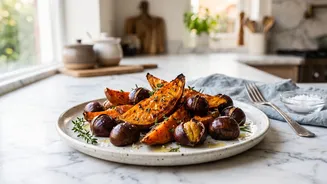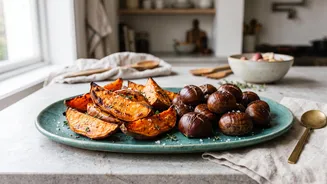


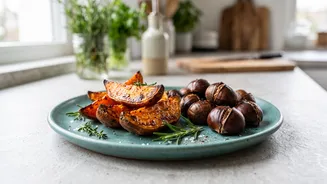

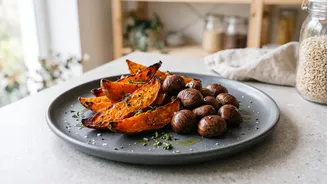
As the weather cools, two seasonal favourites appear: sweet potatoes and chestnuts. While one is a root vegetable and the other a nut, they share a comforting, starchy quality. But when it comes to nutrition, a simple comparison is misleading.
The 100-Gram Showdown
On a gram-for-gram
basis, the differences are stark. A 100-gram serving of roasted chestnuts contains around 245 calories, 53 grams of carbohydrates, and over 5 grams of fibre. In contrast, 100 grams of baked sweet potato has about 90 calories, 20 grams of carbohydrates, and 3-4 grams of fibre. Chestnuts are significantly more calorie-dense and carb-heavy than sweet potatoes when compared by equal weight. Chestnuts are also unique among nuts for being relatively low in fat, with most of their calories coming from carbs.
The Vitamin and Mineral Story
Here, the two diverge dramatically. Sweet potatoes are nutritional powerhouses when it comes to Vitamin A. A single medium sweet potato can provide well over 100% of your daily recommended intake of Vitamin A, thanks to its high beta-carotene content. Chestnuts, on the other hand, contain almost no Vitamin A. However, chestnuts have the upper hand with Vitamin C, providing a significant amount, whereas sweet potatoes offer a more modest dose. Chestnuts are also richer in minerals like potassium and manganese.
Here’s Where It Gets Complicated: Portion Distortion
This is the crucial factor that changes the entire comparison. Nobody eats 100 grams of chestnuts and 100 grams of sweet potato in the same way. A typical portion of sweet potato is one medium-sized tuber, which weighs around 130-180 grams. This is often a substantial part of a meal. A typical serving of chestnuts, however, is a small handful of about 30 grams, or roughly 4-5 nuts. This is usually eaten as a light snack. When you adjust for these realistic portion sizes, the nutritional picture flips.
Sweet Potato: The Filling Meal Component
A medium baked sweet potato (around 150g) provides roughly 135 calories, 30 grams of complex carbohydrates, and about 4.5 grams of fibre. This makes it a filling, low_fat, and incredibly nutrient_dense addition to any meal. The slow_digesting carbs and fibre help with satiety and blood sugar regulation, keeping you fuller for longer. Its huge dose of Vitamin A supports vision and immune function. It serves as a proper, substantial food item that can anchor a plate.
Chestnuts: The Low_Fat,_Snackable_Nut
A _30_-gram snack of roasted chestnuts comes in at around _75_ calories, with about _16_ grams of carbs and _1._5 grams of fibre. This is a light,_satisfying snack that provides a quick energy boost without the heaviness of a full sweet potato. For a nut,_ it's remarkably low in fat._ That small handful also delivers a notable amount of Vitamin C and essential minerals._ So,_ while a _100_-gram comparison makes chestnuts look calorie_laden,_ a real_world portion is a light and sensible choice.