





The Foundation: Why Ankle Stability Matters
Think of your standing foot as the root system of your tree. If the roots are unstable, the entire structure will sway. Ankle stability is your body's ability to maintain control of the joint's position. This task falls to a group of muscles and ligaments
that constantly make tiny adjustments to keep you upright. When you balance on one foot, these muscles work overtime. Tree Pose directly challenges your ankle stability, forcing these supporting tissues to engage and strengthen. Without a stable base, your body has to work much harder, leading to the wobbles and shakes that can make the pose feel frustrating. By focusing on grounding through all four corners of the standing foot, you create a solid foundation, which is the first step to finding stillness.
The Central Powerhouse: More Than Just Abs
When yoga teachers cue 'engage your core,' it's about more than just flexing your abdominal muscles. In yoga, the core is a 360-degree support system that includes your deep abdominal muscles (like the transverse abdominis), your obliques along the sides, and the muscles in your lower back and pelvic floor. This muscular corset stabilizes your spine and pelvis. A strong, engaged core provides a steady centre of gravity, which is essential for any balancing act. Imagine trying to balance a tall pole on your hand; it's much easier if the pole is rigid and centred, not flexible and off-kilter. Your core provides that rigidity for your torso, creating a stable column that your limbs can move around.
The Core-Ankle Connection in Vrikshasana
This is where the magic happens. A stable core and a stable ankle work together. When your core is engaged, it holds your pelvis and spine steady. This prevents larger, destabilizing movements from travelling down your body. With a stable torso, your standing ankle has less work to do. It only needs to make small, subtle micro-corrections to maintain balance, rather than reacting to large shifts in your body weight. Conversely, if your core is disengaged, your hips may tilt or your torso may sway, forcing your ankle to constantly over-correct, which quickly leads to fatigue and loss of balance. Engaging the core first provides a solid anchor, allowing the ankle to do its job more efficiently.
Applying the Principle to Pose Variations
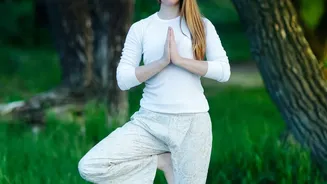
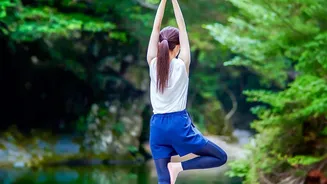
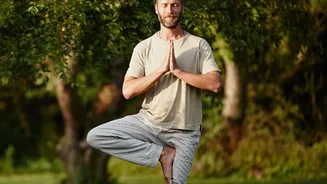
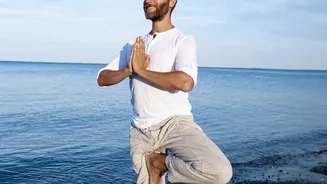
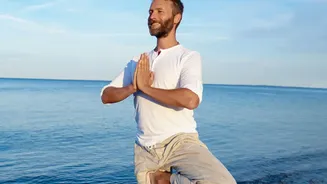
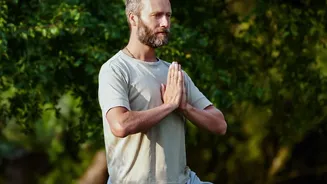
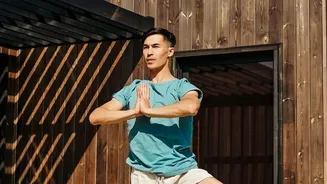
This core-to-ankle relationship holds true across all variations of Tree Pose. For beginners, placing the raised foot on the calf or ankle with hands at the heart is a great starting point. Even in this modified version, keeping the hips level and the core gently drawn in is key to finding balance. As you advance and bring the foot to the inner thigh, the challenge to your stability increases. The mutual pressure between the foot and the thigh creates an active line of energy, but it's the core that prevents the standing hip from collapsing. Raising the arms overhead further elevates your centre of gravity, demanding even greater core control to keep everything aligned and prevent you from tipping over.
Building Strength On and Off the Mat
Improving your Tree Pose involves strengthening these areas both during your yoga practice and with specific exercises. For ankle stability, simple movements like seated ankle rotations and practicing balancing on one foot for short periods can be very effective. For the core, poses like Plank, Boat Pose (Navasana), and Warrior III are excellent for building the deep strength needed for balance. When in Tree Pose, actively think about drawing your navel towards your spine to engage your deep core muscles. Remember to fix your gaze on a non-moving point (drishti) to help calm your mind and body. Consistency is more important than achieving the 'perfect' pose. Practicing near a wall for support is always a great option as you build confidence.