






An Ocean in the Distant Universe
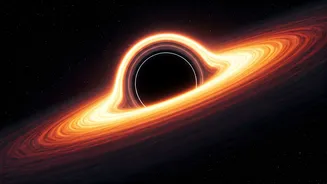
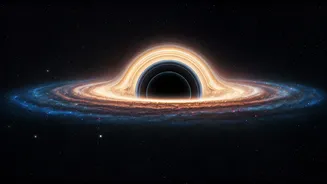
The largest, most distant reservoir of water ever detected is not liquid, but a colossal cloud of water vapor. This enormous mass of water was found surrounding a supermassive black hole at the heart of a quasar—an incredibly luminous and energetic object
in the distant cosmos. The specific quasar, known as APM 08279+5255, is more than 12 billion light-years away from Earth. This incredible distance means we are observing it as it was when the universe was very young, only about 1.6 billion years after the Big Bang. The discovery provides a stunning look back in time, revealing that water was surprisingly abundant even in the early days of the universe.
What is a Quasar, Anyway?
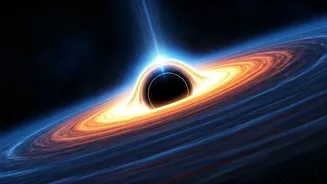
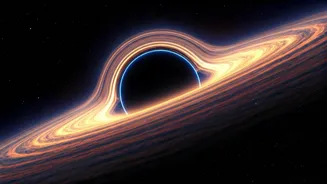
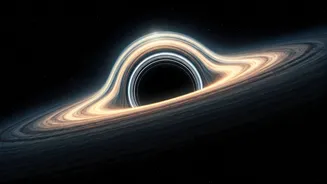
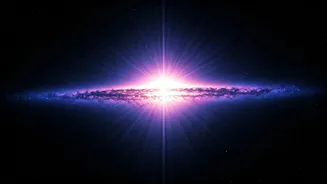
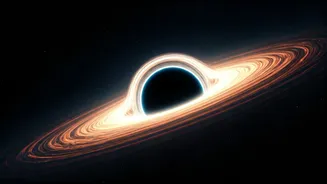
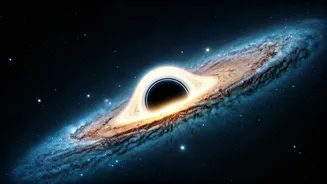
To understand this discovery, it helps to know what a quasar is. A quasar is essentially a galactic core powered by a supermassive black hole that is actively feeding on surrounding gas and dust. As this material spirals into the black hole, it heats up and releases an immense amount of energy, causing the quasar to shine brighter than a thousand trillion suns. APM 08279+5255 is powered by a black hole with a mass 20 billion times that of our sun. This intense energy output plays a crucial role in creating the unique environment where such a massive amount of water vapor can exist.
Not Your Average Glass of Water
The water surrounding this quasar isn't like the water we know. It exists as vapor in a gaseous region that spans hundreds of light-years across. The environment is extreme. While the gas is technically cold at around minus 53 degrees Celsius, it is still five times hotter and up to 100 times denser than what is typically found in galaxies like our own Milky Way. The quasar bathes the gas cloud in X-rays and infrared radiation, creating conditions that are unusually warm and dense by astronomical standards. This radiation is powerful enough to allow the water molecules to form and persist but not so strong that it rips them apart.
How Astronomers Found It
Detecting water from 12 billion light-years away is a monumental task. Two separate teams of astronomers made the discovery using powerful ground-based telescopes. One team used an instrument called Z-Spec at the Caltech Submillimeter Observatory in Hawaii, while another used the Plateau de Bure Interferometer in the French Alps. These instruments operate in the millimeter and submillimeter wavelengths, allowing them to detect the faint spectral signature—or fingerprint—of water molecules from across the universe. By analyzing these signatures, they were able to determine not just the presence of water, but also its immense mass and the physical conditions of its environment.
A Glimpse into the Early Universe
This discovery is more than just a cosmic record-breaker; it fundamentally changes our understanding of the early universe. Scientists had expected to find water vapor in the early cosmos, but they never imagined it would be present in such enormous quantities so soon after the Big Bang. The presence of so much water implies that the building blocks for its formation—namely oxygen—were already widespread. Oxygen is created inside stars and released when they die, so its abundance indicates that generations of stars had already lived and died less than two billion years into the universe's history. This suggests the universe became chemically complex much earlier than previously thought, providing the raw materials for life to potentially emerge elsewhere.