





Your Personal Time Machine
When you look at the stars, you aren't seeing them as they are right now. You're seeing them as they were in the past. This is because light, while incredibly fast, doesn't travel instantaneously. It moves at about 300,000 kilometres per second. That's
quick enough to circle the Earth more than seven times in a single second, but space is vastly, unimaginably big. The distance light travels in one year is called a light-year, which is about 9.5 trillion kilometres. This unit of distance is also a measure of time. When we say a star is 10 light-years away, we mean the light we see from it tonight began its journey a decade ago. Every star in the sky is a window into a different moment in history.
Echoes from our Cosmic Neighbourhood
This effect, known as 'lookback time,' starts right here in our own solar system. The sunlight warming your face left the Sun about 8.3 minutes ago. The light you see reflecting off the Moon is 1.3 seconds old. When you spot Mars in the sky, you're seeing it as it was several minutes ago. But for the stars, the delays become truly epic. The closest star system to us, Proxima Centauri, is about 4.2 light-years away; its light takes more than four years to reach our eyes. The light from Sirius, the brightest star in the night sky, started its journey 8.5 years ago. Vega, a prominent star in the summer sky for northern hemisphere observers, is 25 light-years away. The light you see from it tonight left when you were a quarter-century younger.
Looking at Ancient History
The further you look, the deeper into the past you see. Polaris, the North Star, is a great example. Its light takes around 430 years to reach us. This means the light we see from Polaris tonight set off from the star around the time Akbar was expanding the Mughal Empire. Other stars are even more distant. The light from Rigel, a brilliant blue-white star in the constellation of Orion, has been travelling for about 860 years. When you gaze at it, you're seeing light that started its journey during the Chola dynasty's peak in Southern India. This concept transforms stargazing from a simple hobby into a profound connection with the past. You're not just looking at stars; you're looking at history.
A Universe of Ghosts and Galaxies
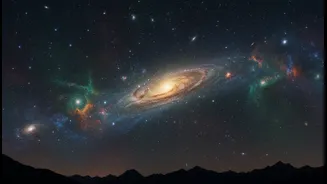
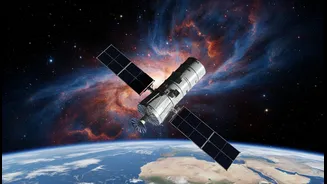
The implications of lookback time are mind-bending. For very distant stars, it's possible the star we are seeing has already died, perhaps in a supernova explosion, but its final burst of light hasn't reached us yet. We are watching a celestial ghost. On an even grander scale, this principle allows astronomers to be cosmic archaeologists. With a good pair of binoculars or a small telescope in a dark area, you might spot a faint, fuzzy patch of light known as the Andromeda Galaxy. That light has travelled for 2.5 million years to reach you. When those photons began their journey, our earliest human ancestors were first appearing on Earth. Powerful telescopes like the Hubble and James Webb can see galaxies whose light has travelled for over 13 billion years, giving us a glimpse of the universe in its infancy.
Why This Changes Everything for Skywatchers
Understanding deep time enriches the experience of skywatching immeasurably. It shifts your perspective from seeing a static, two-dimensional dome of stars to perceiving a four-dimensional universe with incredible depth and history. Each point of light has a story, a distance, and an age. The night sky is no longer just beautiful; it's a dynamic museum of cosmic evolution. It connects you not just to the vastness of space, but to the immense passage of time. The simple act of looking up becomes an act of time travel, a direct link to the universe's grand, unfolding narrative. It reminds us that everything we see is a snapshot from the past, a story told across trillions of miles and millions of years, delivered to our eyes tonight.