




The Growing Threat Above
For decades, every rocket launch and satellite deployment has left something behind. Today, an estimated 7,600 tonnes of space junk orbit our planet, from defunct satellites and spent rocket stages to tiny fragments of metal. While a stray paint chip
might seem harmless, in orbit it travels at speeds approaching 30,000 miles per hour. At that velocity, even a small object can strike with the force of a hand grenade, capable of disabling a critical weather or communications satellite. Experts worry about a chain reaction known as the Kessler Syndrome, where one collision creates a cloud of new debris, which in turn causes more collisions, eventually rendering certain orbits unusable. To prevent this, simply stopping the creation of new debris isn't enough; we need to actively clean up the most dangerous objects already there.
Why a Harpoon Makes Sense
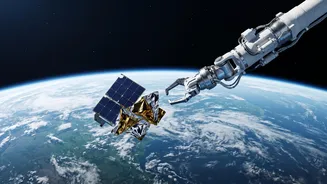
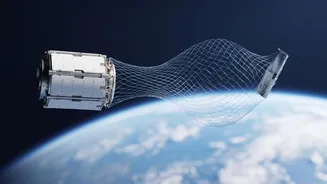
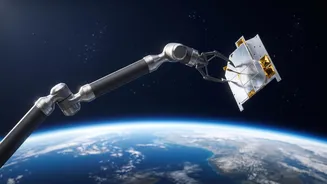
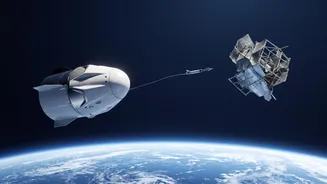
Active debris removal presents immense challenges. The targets are often tumbling unpredictably and moving at incredible speeds. While solutions like nets and robotic arms are being developed, the harpoon offers unique advantages. It is a relatively simple, lightweight, and compact system, meaning a removal spacecraft could potentially carry several. A key benefit is that the capturing spacecraft, or 'chaser', can fire the harpoon from a safe distance, typically around 10 meters, without needing to perform a complex and risky docking maneuver with an uncooperative, spinning target. The capture process is incredibly fast—often under a second—making it less sensitive to the target's rotation. This combination of simplicity and effectiveness makes the harpoon a leading candidate for tackling large, high-risk targets like old rocket bodies.
Anatomy of a Space Harpoon
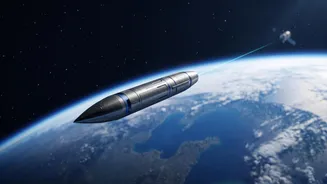
A space harpoon is far more sophisticated than its ancient counterpart. The projectile itself is meticulously designed for a very specific job: to pierce the skin of a satellite or rocket body without creating more debris. Engineers have tested various head shapes, from conical to ovoid, to find designs that 'petal' the target's metal skin inward rather than punching a hole and sending fragments flying. Behind the penetrating tip, a set of barbs is designed to deploy passively after impact, securing the harpoon inside the target. To absorb the shock of impact, a crushable section is often built into the harpoon's body. The so-called 'laser' in the headline typically refers not to a weapon, but to the guidance system. A LiDAR (Light Detection and Ranging) system uses laser pulses to measure the distance, shape, and rotation of the target with extreme precision, ensuring the harpoon hits its mark. Once attached, a tether connecting the harpoon to the chaser satellite allows it to reel the debris in or, more likely, drag it into a new orbit where it will safely burn up in Earth's atmosphere.
From Theory to In-Orbit Testing
The concept of a space harpoon is no longer just on the drawing board. The European-funded RemoveDEBRIS mission, led by the University of Surrey and a consortium of space companies including Airbus, successfully tested a harpoon in orbit. In the experiment, a harpoon was fired at 20 meters per second into a satellite panel extended on a boom, successfully penetrating and capturing it. The mission also tested other key technologies, including a net to capture a target and a vision-based navigation system to track debris. This successful demonstration was a major step in proving that the technology is a viable solution to the space junk problem. Building on these successes, companies like Astroscale and agencies like the European Space Agency (ESA) are planning more advanced missions to rendezvous with, inspect, and eventually capture real-world debris.
Challenges and the Future
Despite successful tests, significant hurdles remain. Each removal mission is incredibly expensive, running into tens or even hundreds of millions of euros. There are also complex legal and liability questions about who is responsible for defunct satellites. Furthermore, while harpoons are great for large objects, they can't address the millions of smaller, untrackable pieces of debris. The ultimate goal is to remove about five large objects per year from the most congested orbits, which models suggest could be enough to stabilize the debris environment. As the commercial space industry grows, developing reliable and cost-effective removal technologies like the laser-guided harpoon is not just an engineering challenge, but a critical necessity for ensuring the future of space exploration and the satellite-based services we rely on every day.