
The Power of an Infrared Eye
Imagine trying to see through a thick cloud of smoke. Visible light struggles to get through, scattering off the dense particles. It’s the same problem astronomers face when studying star-forming regions, also known as stellar nurseries. These vast clouds
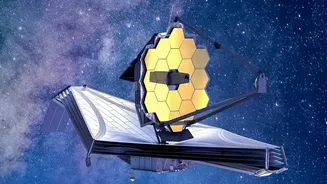
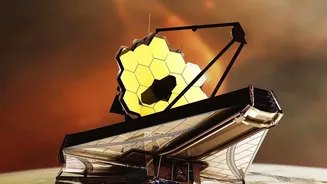
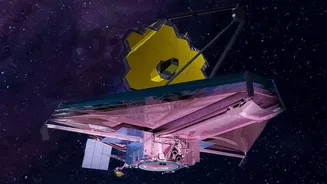
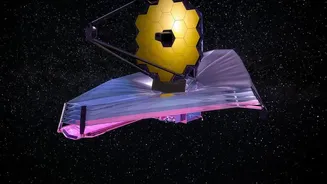
of cosmic dust are opaque to traditional telescopes that see in visible light, like Hubble. This is where the James Webb Space Telescope (JWST) changes the game. JWST is designed to see the universe in infrared light—wavelengths longer than the light our eyes can detect. This longer-wavelength light can slip past the tiny dust grains much more easily, allowing the telescope to peer deep inside these nurseries and witness the birth of stars, a process that was previously obscured. It’s like having a superpower that lets you see through walls, but on a cosmic scale, revealing a hidden universe of creation.
A Glimpse Inside Sagittarius B2
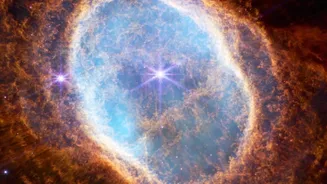
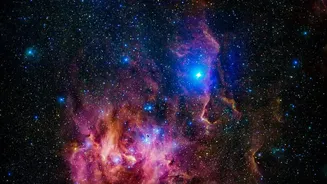
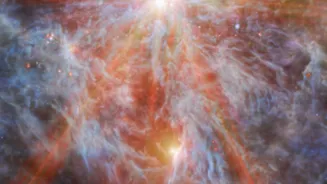
One of the most spectacular recent examples comes from Webb's observations of Sagittarius B2, the most active and massive star-forming cloud in our entire Milky Way galaxy. Located near the supermassive black hole at the galactic center, this region is an engine of creation, responsible for producing half of all new stars in the galactic core despite containing only 10% of its star-making gas. Thanks to Webb’s near-infrared and mid-infrared instruments, scientists have been given an unprecedentedly detailed view of this chaotic environment. The images show the brilliance of newly formed stars, still wrapped in their warm, dusty cocoons, and have revealed stars that were completely invisible before, their light buried under thick layers of gas.
Unveiling Cosmic Marvels
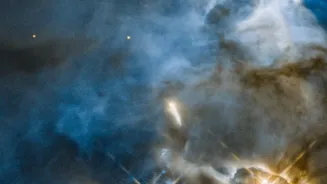
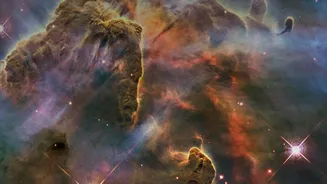
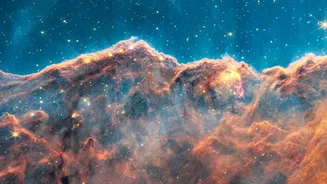
Within these nurseries, Webb is revealing the dynamic and often violent process of star birth. Instead of a slow, gentle collapse, the imagery shows a much more active scene. In regions like the famous 'Cosmic Cliffs' of the Carina Nebula, powerful radiation and stellar winds from massive young stars carve out giant cavities in the surrounding gas and dust. This pressure can both trigger the formation of new stars by compressing gas and dust, but also destroy the raw material needed for others to form. In other nurseries, like the Rho Ophiuchi cloud complex, Webb has captured dramatic jets and outflows of material being blasted into space by infant stars. These powerful emissions slam into the surrounding gas at high speeds, creating glowing shock waves and intricate structures that tell the story of a star's first moments.
Rewriting Our Understanding of Star Birth
These incredible images are more than just beautiful cosmic portraits; they are providing data that is forcing scientists to rethink long-held theories about how stars form. For years, models of star formation were based on limited observations. Webb is showing that star birth might be a more chaotic and dynamic process than previously thought. By studying the chemical composition and structure of these regions, like the Tarantula Nebula, which resembles star-forming regions from the early universe, astronomers can get a clearer picture of how galaxies themselves evolved over cosmic time. Intriguingly, even Webb has its limits. In some of the new images of Sagittarius B2, there are dark patches that appear empty. In reality, these are areas so dense with gas and dust that not even Webb's infrared vision can penetrate them—the future sites of brand new stars.