

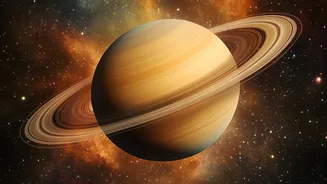

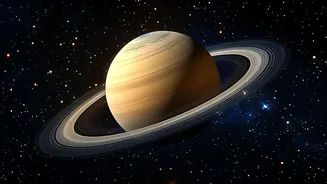
It’s a Newly Forming 10-Sided Storm
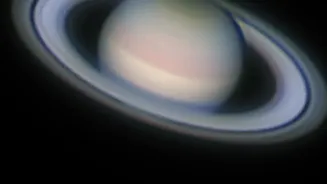
The feature Hubble is tracking is a massive, evolving atmospheric wave with ten distinct sides, leading scientists to nickname it a 'decagon'. This discovery, announced in September 2026, marks the first time a large, regular-sided jet stream pattern
has been seen in Saturn's southern hemisphere. For decades, scientists have known about a persistent six-sided storm, the hexagon, at the planet's north pole. However, this new southern feature appears to be a recent development, giving astronomers a rare and exciting opportunity to watch a giant planetary storm system as it forms and strengthens in near real-time.
Scientists Have Been Hunting for It for Decades
The discovery of the northern hexagon decades ago led astronomers to wonder if a similar, symmetrical feature existed at the south pole. For over 30 years, researchers have been searching for a southern counterpart. Even NASA's Cassini spacecraft, which orbited Saturn from 2004 to 2017, found no trace of such a long-lived structure. The planet's axial tilt meant the south pole was hidden from Earth's view for many years. It only became visible again in 2023, allowing the long search to finally yield results, with Hubble confirming what ground-based observers had begun to suspect.
Hubble's OPAL Program Was Key to the Discovery
This finding was made possible by Hubble's Outer Planet Atmospheres Legacy (OPAL) program. This long-term project dedicates some of the space telescope's time each year to photographing the outer planets—Jupiter, Saturn, Uranus, and Neptune. Rather than providing a single snapshot, OPAL allows scientists to monitor these distant worlds over many years, tracking seasonal changes and identifying new phenomena. By piecing together annual observations of Saturn dating back to 2023, researchers could spot the subtle emergence of the decagon's structure before it became a clearly defined pattern.
The Decagon Is a Deep, Multi-Layered Structure
Unlike a surface-level weather event, the southern decagon is a massive, vertically extended structure. Observations show that the wave pattern extends through multiple layers of Saturn's atmosphere. It sits within one of the planet's powerful jet streams. When viewed through different light filters, which probe different altitudes, its apparent position shifts slightly, confirming it is not just a feature of the cloud tops but a deep atmospheric disturbance. This complexity is part of what makes it so intriguing to planetary scientists trying to understand the forces that power weather on gas giants.
Its Future Remains a Complete Mystery
The biggest question for scientists is why this decagon formed now, when nothing like it had been seen before. Is it a transient phenomenon, or will it become a stable, long-lasting feature like the northern hexagon, which has been churning for over 40 years? Researchers are unsure if the decagon will stabilize, change shape, or dissipate entirely. Continued observations with Hubble, alongside other powerful instruments like the James Webb Space Telescope, will be crucial. Scientists hope that by monitoring its evolution, they can unlock new insights into the atmospheric dynamics that govern not only Saturn but also other giant planets and even Earth.