






The Cosmic Bottleneck
Since the dawn of the Space Age, we have relied on radio waves to communicate with probes sent to the far reaches of our solar system. This tried-and-true method has been remarkably successful, but it has a fundamental limitation: bandwidth. As our scientific
instruments become more sophisticated, capable of capturing high-definition images, video, and vast amounts of complex data, radio frequency systems are struggling to keep up. Transmitting a complete, high-resolution map of Mars, for instance, could take weeks or even months. It’s a bit like trying to stream an HD movie over an old dial-up modem; the data pipeline is simply too narrow for the amount of information we want to send, creating a significant bottleneck for cosmic exploration.
A Solution Written in Light
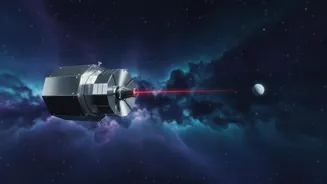
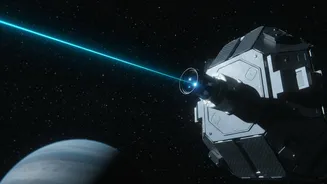
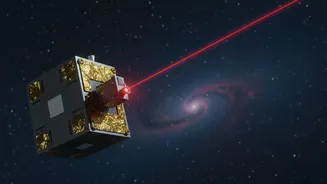
The solution is to move from radio waves to light itself. NASA's Deep Space Optical Communications (DSOC) technology represents a paradigm shift, upgrading our interplanetary network from radio to laser. Instead of broad radio waves, DSOC uses focused beams of near-infrared light, which is invisible to the human eye. The physics is straightforward: light, specifically infrared, has a much higher frequency than radio waves. This higher frequency allows engineers to pack vastly more data into each transmission. The result is a communication system with the potential to be 10 to 100 times faster than the state-of-the-art radio systems currently in use on spacecraft, without requiring more mass or power.
How It Actually Works
The DSOC system has three main components: a flight transceiver on the spacecraft, a powerful laser transmitter on the ground, and a massive telescope receiver on Earth. The process begins with the ground station at a place like JPL's Table Mountain facility firing a powerful laser beacon toward the spacecraft. The flight transceiver, mounted on the spacecraft, locks onto this beacon. It then uses its own, much smaller laser to encode data—like HD video or scientific telemetry—into photons and sends them hurtling back to Earth in a narrow, focused beam. This beam is received by the 200-inch Hale Telescope at Caltech's Palomar Observatory, which is outfitted with highly sensitive superconducting detectors capable of counting individual photons.
The Psyche Mission's Triumph
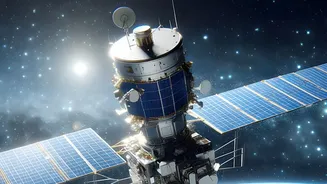
This technology isn't just theoretical; it's being proven right now across millions of kilometers of space. The DSOC system is a technology demonstration aboard NASA's Psyche spacecraft, which launched in October 2023. In a landmark achievement, the system streamed an ultra-high-definition video from 19 million miles away at a stunning 267 megabits per second (Mbps), a rate comparable to terrestrial broadband internet. More recently, in April 2024, it successfully transmitted engineering data from the spacecraft over a distance of 140 million miles (226 million kilometers). These tests have far exceeded expectations, proving that laser communications can provide a robust link even at vast interplanetary distances.
Overcoming Extreme Challenges
Beaming a laser across millions of kilometers is incredibly difficult. The primary challenge is precision. The laser beam is extremely narrow, so pointing it accurately is like trying to hit a moving coin from kilometers away while you are also moving. The system must account for the constant motion of both the spacecraft and Earth. To achieve this, the flight transceiver is mounted on a special stabilization assembly that isolates it from spacecraft vibrations. Another major hurdle is Earth's atmosphere, as clouds and even atmospheric turbulence can disrupt the signal. To mitigate this, ground systems use adaptive optics—deformable mirrors that compensate for atmospheric distortion in real-time—and NASA is exploring networks of ground stations to ensure there's always a clear line of sight.