




The Magic Number for a Perfect Cup
At its core, the 'golden ratio' is a guideline for the ideal proportion of coffee grounds to water. Championed by the Specialty Coffee Association (SCA), this standard provides a reliable starting point for brewing. While the official SCA 'Golden Cup'
standard is about 1 gram of coffee to 18 grams of water (a 1:18 ratio), most coffee lovers and specialty shops find their sweet spot in a slightly stronger range, from 1:15 to 1:17. Think of it this way: for every gram of coffee you use, you'll want to use 15 to 17 grams of water. This isn't an arbitrary rule; it's based on the science of extraction, ensuring you pull just the right amount of flavour from the grounds without getting a weak, sour cup (under-extraction) or a harsh, bitter one (over-extraction).
Why Measuring by Weight Matters
While using tablespoons is a common practice at home, it's not the most reliable. Two tablespoons of a dark, oily roast can weigh significantly less than two tablespoons of a dense, light roast. This variation is why your coffee might taste different from one day to the next, even if you use the same number of scoops. To truly harness the power of the golden ratio, you need one crucial tool: a digital kitchen scale. They are inexpensive and the single most effective upgrade for your home coffee setup. By weighing both your coffee and your water (remembering that 1 millilitre of water equals 1 gram), you introduce precision and consistency, making it possible to repeat that 'perfect cup' every single time.
Your Step-by-Step Guide
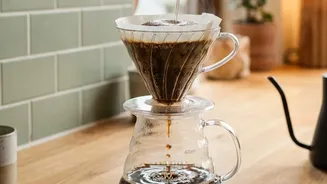
Let's put the ratio into practice. We'll aim for a balanced 1:16 ratio, perfect for a standard pour-over or drip machine. If you want to make a single 12-ounce mug (about 340 grams of coffee), here's the math: divide your water weight by the ratio number (340 ÷ 16 = 21.25). So, you'll need about 21 grams of coffee. 1. Measure and Grind: Weigh out 21 grams of whole bean coffee and grind it to a medium consistency, similar to table salt. 2. Heat Your Water: Bring your water to a temperature between 195-205°F (90-96°C). If you don't have a temperature-controlled kettle, just bring it to a boil and let it sit for about 30 seconds. 3. Prepare Your Brewer: Place your filter in your brewer, put it on top of your mug, and place the entire setup on your scale. Rinse the paper filter with hot water to remove any paper taste, empty the mug, and then tare the scale to zero. 4. Add Coffee and Bloom: Add your 21 grams of ground coffee and tare the scale to zero again. Start a timer and pour in about 40-50 grams of water, ensuring all grounds are wet. This is the 'bloom,' which releases trapped CO2 gas. Let it sit for 30-45 seconds. 5. Continue Pouring: Slowly pour the remaining water in a circular motion until the scale reads 340 grams. Aim to finish your pour around the 2:30 to 3:00 minute mark.
Adapting for Different Brewing Methods
The golden ratio is a starting point, not a strict law. Different brewing methods require slight adjustments because of how they extract flavour. French Press: This is a full-immersion method, meaning the coffee and water are in contact for a long time. To prevent over-extraction, many prefer a slightly stronger ratio, around 1:12 to 1:15, with a coarse grind. AeroPress: This versatile brewer works well with many ratios. For a standard cup, a 1:12 to 1:16 ratio is common. For a concentrated, espresso-style shot that you'll dilute with hot water, you might use a much tighter ratio like 1:6. * Cold Brew: Since cold water extracts flavour much more slowly, you need a highly concentrated ratio. For a concentrate that you will dilute later with water or milk, a ratio between 1:4 and 1:8 is standard.
Find Your Personal Golden Ratio
The beauty of the 1:16 or 1:17 starting point is that it empowers you to experiment. Consider it your baseline. Do you prefer a bolder, more robust cup? Try a 1:15 ratio next time. If you enjoy a lighter, more delicate flavour profile, especially with black coffee, try a 1:17 or 1:18 ratio. The type of bean, roast level, and even the quality of your water will influence the final taste. The goal isn't to rigidly follow a rule but to use the rule as a guidepost. Start with the standard, pay attention to what you taste, and don't be afraid to make small adjustments until you land on the brew that is perfect for you.