




A Mystery in the Deep
Imagine astronomers scanning the skies and detecting a sudden, brilliant burst of energy from a point of light billions of light-years away. This isn't science fiction; it's a frequent occurrence in modern astronomy. The object could be a quasar, a type
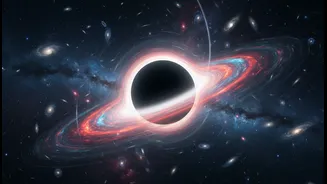
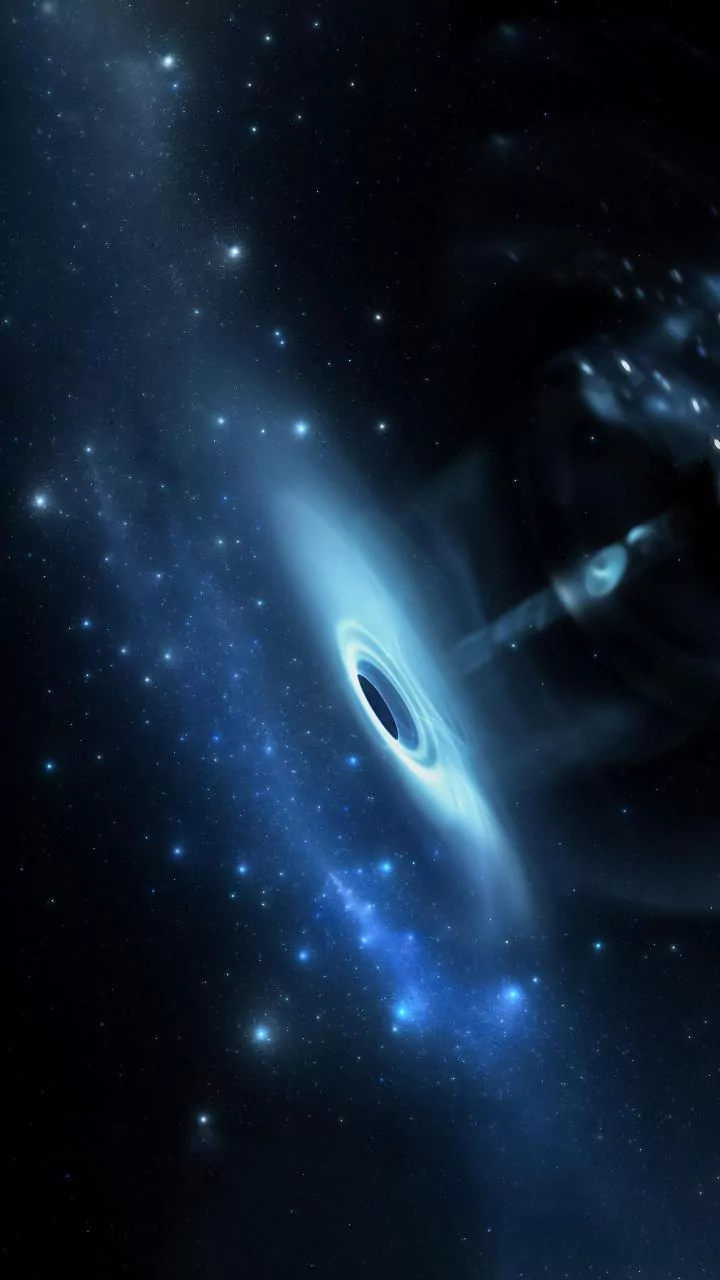
of active galactic nucleus (AGN), where a supermassive black hole is voraciously feeding on surrounding gas and dust, releasing immense energy. When such an object ‘switches on’ or flares up, the first task for scientists is to determine its place in the cosmic map. Knowing its distance is fundamental. It unlocks other properties like its true size, its intrinsic brightness, and its mass, placing it within the grand story of the universe's evolution. But how do you measure a distance so mind-bogglingly large?
The Cosmic Distance Ladder
You can't just stretch a measuring tape across the universe. Astronomers have developed a suite of ingenious methods collectively known as the Cosmic Distance Ladder. It's called a ladder because no single technique works for all distances. Each method serves as a 'rung' that can measure a certain distance range. These rungs are calibrated against each other; a method for nearby objects helps confirm the accuracy of a method for more distant ones, allowing astronomers to step further and further out into the cosmos with confidence. It's a multi-step process that combines direct geometry, clever observations, and our understanding of physics.
Rung 1: Parallax for the Neighbours
The foundational rung of the ladder is stellar parallax. You can experience this effect right now. Hold your thumb out at arm's length, close one eye, and note your thumb's position against the background. Now switch eyes. Your thumb appears to jump. This apparent shift is parallax. Astronomers do the same, but instead of blinking, they use Earth's orbit. They measure a nearby star's position against very distant background stars and then measure it again six months later when Earth is on the opposite side of the Sun. The tiny shift in the star's apparent position allows them to use simple trigonometry to calculate its distance. This method is incredibly precise but only works for relatively nearby stars within our own Milky Way galaxy, up to a few thousand light-years away.
Rung 2: The Brightness of Standard Candles
To look deeper into space, astronomers need a different tool: 'standard candles'. A standard candle is an object that has a known, predictable intrinsic brightness. Imagine you have a 100-watt light bulb. If you see it from across a field, you can estimate how far away it is based on how dim it appears. Astronomers use specific types of stars and stellar explosions for this. Cepheid variable stars are one example; these stars pulsate, and the time they take to pulse is directly related to their true brightness. By measuring their pulsation period, astronomers know how bright they really are and can calculate their distance. For even greater distances, they use Type Ia supernovae, which are powerful stellar explosions that all reach the same peak luminosity, making them excellent mile-markers for galaxies millions of light-years away.
Rung 3: Redshift and the Expanding Universe
For a truly distant object like our supermassive anomaly, which lies far beyond the reach of standard candles, astronomers use the expansion of the universe itself as a ruler. The universe is expanding, and this expansion stretches the wavelengths of light traveling through it. Light from objects moving away from us is shifted toward the red end of the spectrum—an effect called cosmological redshift. Edwin Hubble discovered that the farther away a galaxy is, the greater its redshift, meaning it's receding from us faster. This relationship, known as Hubble's Law, is the ultimate tool for measuring the largest distances in the cosmos. By capturing the light from the anomaly and measuring its redshift, astronomers can directly calculate its distance.
Solving the Anomaly's Puzzle
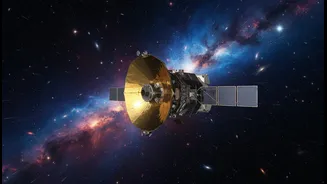
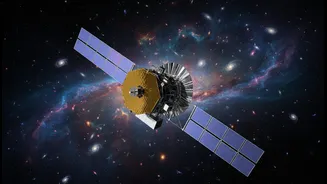
So, for the newly activated supermassive cosmic anomaly, astronomers would use a powerful telescope to capture its spectrum. They would identify characteristic spectral lines and see how much they have been shifted towards red. This redshift value (z) is plugged into the equations of cosmology, revealing just how far the light has traveled across the expanding universe. The distance would be staggering, likely billions of light-years. Techniques like 'echo mapping', which measure the time delay between light flares from the black hole's accretion disk and the light's reflection off a surrounding dust torus, can also provide a direct geometric distance to these active galactic nuclei, helping to refine the distance ladder even at these cosmic scales. Each method builds upon the last, forming a chain of reasoning that connects us to the farthest reaches of space and time.