




A Sweet Discovery in Deep Space
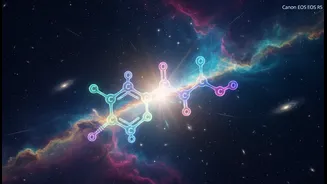
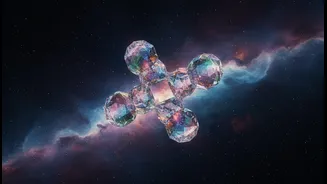
In a vast, cold molecular cloud near the center of our Milky Way, astronomers have detected something remarkable: erythrulose. This isn't just any molecule; it's a four-carbon sugar, a class of organic compound essential for life as we know it. On Earth,
you might find it in trace amounts in red raspberries or even in sunless tanning lotions. But finding it floating in a gas and dust cloud some 26,000 light-years away is a groundbreaking achievement. Using powerful radio telescopes in Spain, an international team of researchers identified the faint radio signature of erythrulose, confirming for the first time that a true sugar can exist in the interstellar medium—the raw material from which stars and planets are born.
More Than Just an Ingredient
The discovery is significant because sugars are fundamental to biology. They serve as energy sources and, crucially, form the structural backbone of RNA and DNA. Scientists have long wondered how these vital molecules came to be on early Earth. While sugars like ribose have been found on meteorites and asteroids before, detecting one directly in interstellar space suggests their origins go back even further, to before planets even form. Erythrulose is particularly interesting because it can be converted into other important sugars, and it is considered a possible precursor to the very first genetic material, which may have been simpler than the RNA we know today. Its presence suggests that the chemical ingredients for life could be widespread throughout the galaxy.
Why This Isn't 'Alien Life'
It’s tempting to hear “organic molecules in space” and jump to conclusions about aliens. However, scientists are exercising extreme caution, and for good reason. There is a vast difference between a prebiotic molecule—a chemical building block of life—and life itself. Finding bricks and lumber at a construction site doesn't mean a house has been built. Similarly, erythrulose is an ingredient, not the finished product. Astrobiologists are keenly aware of the risk of 'false positives,' where a signal seems to indicate life but is actually caused by non-biological processes. The history of science is filled with moments where exciting signals turned out to have perfectly natural, non-living explanations. This discipline is essential to ensuring that when a claim of extraterrestrial life is finally made, it is built on an unshakable foundation of evidence.
The High Bar for Evidence
The search for extraterrestrial life is one of the most profound quests in human history, and because of that, the standard of proof is extraordinarily high. Announcing the discovery of alien life would be a civilization-altering event. A premature or incorrect announcement could undermine public trust in science and create confusion. This is why scientists emphasize a methodical approach. The discovery of erythrulose doesn't prove life exists elsewhere; it proves that a complex chemical pathway necessary for life can occur naturally in the cosmos. This tells us that the universe is a competent chemist, capable of creating complex organic structures even in the freezing vacuum between stars. This understanding helps scientists refine their models of where and how to look for life, but it is a single step on a very long journey.
What Really Comes Next
The detection of erythrulose is a beginning, not an end. It opens the door for astronomers to search for other, even more complex sugars and prebiotic molecules in space, like ribose, the five-carbon sugar at the heart of RNA. Each new molecule found adds another piece to the puzzle of life's origins. Future missions and more powerful telescopes will continue to scan molecular clouds, protoplanetary disks, and the atmospheres of distant exoplanets. The goal is to build a complete inventory of the universe's organic chemistry. By understanding the chemical context—what molecules form, where they form, and in what quantities—scientists can better identify a true 'biosignature'—a sign that could only be produced by living organisms. The true next step is not a declaration, but deeper, more patient investigation.