


A Glimpse into Alien Skies
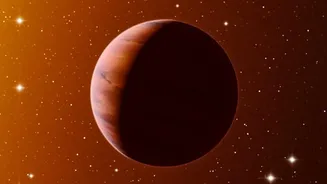
The James Webb Space Telescope has potentially detected atmospheres, some containing hints of water vapour, around several rocky exoplanets. One notable candidate is 55 Cancri e, a blistering hot 'Super-Earth' about 41 light-years away. Instead of being
a bare rock exposed to space, data suggests it may be shrouded in a substantial atmosphere, possibly rich in gases like carbon dioxide or carbon monoxide that are bubbling from a molten rock ocean below. Another fascinating subject is GJ 486 b, a rocky world where JWST found intriguing hints of water. However, scientists are cautiously optimistic, as the signal could potentially be coming from cool spots on the planet's host star rather than the planet itself. These findings represent the best evidence to date for atmospheres on rocky planets outside our solar system, a critical step toward understanding planetary diversity.
What Are Super-Earths?
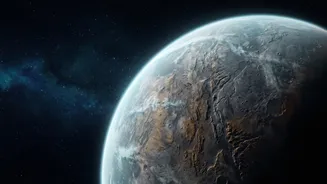
The term 'Super-Earth' might conjure images of a bigger, better version of our own planet, but it's a simple classification based on size and mass. Super-Earths are exoplanets with a mass higher than Earth's but substantially below those of our solar system's ice giants, Uranus and Neptune. These planets can be rocky, ocean worlds, or even have dense, gassy envelopes. For example, LHS 1140 b, another Super-Earth studied by JWST, is about 1.7 times the size of Earth and 5.6 times its mass. Initial theories suggested it could be a dense rocky planet, but recent data indicates it's more likely an 'ocean world' containing a significant amount of water. These worlds are common in our galaxy, yet our own solar system lacks one, making them a primary target for astronomers eager to understand the full spectrum of planet formation.
The Telescope's Secret Weapon
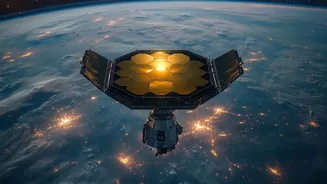
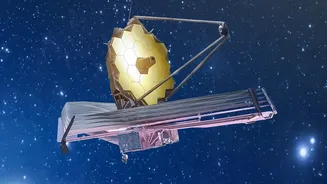
So how does JWST peer into the atmosphere of a planet light-years away? It uses a technique called transmission spectroscopy. As an exoplanet passes in front of its host star from our point of view (an event called a 'transit'), the star's light filters through the planet's atmosphere. Different gas molecules in the atmosphere absorb specific wavelengths, or colours, of light. This leaves a unique chemical 'fingerprint' in the light that ultimately reaches the telescope. JWST's highly sensitive infrared instruments, like the Near-Infrared Spectrograph (NIRSpec) and Mid-Infrared Instrument (MIRI), are specifically designed to capture these faint signals. By analysing this spectrum of light, astronomers can deduce which gases are present, their temperature, and even hints about clouds. It’s this remarkable capability that allowed scientists to spot the potential signs of water and other atmospheric gases on planets like 55 Cancri e and GJ 486 b.
Why Water Vapour Matters
The detection of water vapour is a monumental step in the search for habitable worlds. On Earth, liquid water is a fundamental requirement for all known life. Finding water, even as a gas in a scorching hot atmosphere, tells astronomers that the basic ingredients for life can and do exist on rocky planets around other stars. For a planet like 55 Cancri e, which is far too hot for liquid water, the presence of a secondary atmosphere replenished by its own magma ocean demonstrates that rocky planets can maintain atmospheres even in extreme environments. For planets within the 'habitable zone'—the orbital range where liquid water could exist on a planet's surface—the presence of atmospheric water vapour would be even more profound. Discoveries on worlds like LHS 1140 b suggest that some Super-Earths might be true water worlds, potentially covered in deep oceans.
The Next Frontier in Discovery
These initial findings are just the beginning. The data from JWST is complex, and scientists are working to confirm these atmospheric detections and rule out alternative explanations, like stellar contamination. For many of these planets, further observations are already planned using different instruments aboard JWST to get a more complete picture. The study of 55 Cancri e has opened up new theories about how lava worlds can sustain atmospheres, suggesting their molten surfaces act as a reservoir, constantly replenishing the gases that are stripped away by intense stellar radiation. The case of LHS 1140 b, a cooler world in its star's habitable zone, may present the best opportunity yet to characterize a potentially habitable planet. Each new observation brings us closer to answering one of humanity's oldest questions: Are we alone in the universe?