



Meet Euclid, the Dark Universe Detective
Launched in July 2023, the European Space Agency's (ESA) Euclid telescope has a grand mission: to map the 'dark Universe'. Its primary goal is to investigate the enigmatic dark matter and dark energy that shape our cosmos. To do this, Euclid is charting
a 3D map of the universe by observing billions of galaxies stretching back 10 billion years in time. Positioned 1.5 million kilometers from Earth, it's equipped with a 600-megapixel camera and infrared instruments that give it a unique vantage point. While its main quest is the dark universe, this powerful observatory is proving to be an exceptional tool for hunting other cosmic treasures.
What Exactly is a Quasar?
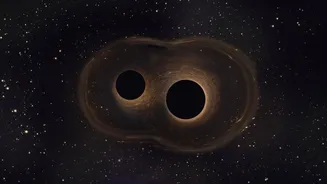
Imagine a supermassive black hole, with the mass of millions or billions of suns, sitting at the center of a young galaxy. Now, imagine it in a feeding frenzy, pulling in enormous amounts of gas and dust. The intense gravitational forces heat this swirling matter to millions of degrees, causing it to shine with incredible ferocity. This blazing galactic core is a quasar. They are so luminous they can outshine their entire host galaxy by hundreds of times, making them the brightest and most energetic objects in the cosmos. Because their light takes billions of years to reach us, observing them is like looking back in time to the universe's infancy.
Hiding in Plain Sight
If quasars are so bright, why are they hard to find? The answer lies in their rarity and extreme distance. The hyper-luminous quasar phase is just a brief moment in a galaxy's multi-billion-year life. Catching a galaxy in this act is a matter of luck. The most ancient quasars, those from the first billion years of the universe's existence, are especially elusive. Their light is incredibly faint by the time it reaches us, and it gets stretched into infrared wavelengths, making them easy to confuse with the light from much closer stars. Before Euclid, finding these ancient objects was a slow, painstaking process that often only spotted the most exceptionally bright examples, just the tip of the iceberg.
The Power of a Wide Gaze
This is where Euclid’s “wide view” becomes a game-changer. Telescopes like Hubble provide incredibly deep, sharp images, but of very small patches of the sky. In contrast, Euclid combines Hubble-like sharpness with the ability to survey vast swathes of the cosmos quickly. Each pointing captures an area 270 times larger than a Hubble image. Over its mission, the Euclid Wide Survey will cover about one-third of the entire sky. This allows astronomers to move from hunting individual quasars to taking a full census. Instead of just finding the brightest few, Euclid can efficiently search huge areas to detect the fainter, more typical quasars that previous surveys missed.
A Treasure Trove of Discoveries
And it's already paying off. As of July 2026, Euclid has identified an unprecedented 31 new quasars from the universe's first 800 million years. This discovery has more than doubled the number of known quasars from this ancient epoch in just over a year of observations—a feat that previously took astronomers a decade to achieve for a smaller number. Among the discoveries are the two most distant quasars ever seen, shining when the universe was only 670 million years old. This haul provides the first large sample of these objects, allowing scientists to study them as a population and better understand one of the biggest mysteries in astrophysics: how supermassive black holes grew so large, so quickly, in the early universe.