



The Junkyard Above Our Heads
For over sixty years, humanity has been sending rockets and satellites into orbit. While these have revolutionized modern life, they've left a legacy of waste. Currently, there are millions of pieces of 'space junk' circling the planet at incredible speeds—up
to 28,000 kilometres per hour. This debris ranges from entire defunct satellites and spent rocket stages to tiny fragments from collisions. The danger is immense; even a small paint chip can cause catastrophic damage to an operational satellite or a crewed spacecraft. Experts warn of the 'Kessler Syndrome,' a theoretical tipping point where collisions create so much new debris that it triggers a runaway chain reaction, potentially rendering low-Earth orbit unusable for generations.
The Magnetic Approach: A Cosmic Gripper
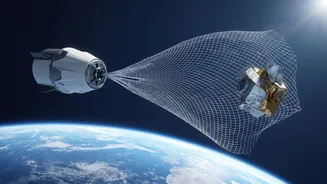
One of the most promising solutions involves magnetism. Companies like Japan's Astroscale are pioneering this technology. Their approach doesn't use a simple 'net' but a sophisticated capture system. Many satellites being launched today are being built with a standardized ferromagnetic plate. A 'servicer' spacecraft can then approach the defunct satellite, dock with it magnetically, and then fire its thrusters to guide the junk into a new trajectory where it will burn up safely in Earth's atmosphere. For older, 'unprepared' debris that lacks a docking plate, engineers are developing robotic arms and even techniques using spinning magnets that create eddy currents to control and move non-magnetic but conductive objects like aluminum. Astroscale's ELSA-M mission, planned for 2026, aims to demonstrate the removal of multiple satellites in a single mission.
The Laser Solution: A Gentle Nudge
Another futuristic method involves using high-powered lasers, either from the ground or from a dedicated satellite. The idea isn't to blast the debris to pieces—which would only create more junk. Instead, the laser focuses on a small spot on the target's surface. This intense heat causes a tiny part of the surface to vaporize, a process called ablation. The vaporized material expanding away from the object acts like a micro-thruster, creating a gentle but persistent push. Over time, these small nudges can alter the debris's orbit enough to cause it to re-enter and disintegrate in the atmosphere. This non-contact method is ideal for dealing with smaller, more numerous pieces of debris that are hard to capture physically.
The Race to Clean Up Space
A new commercial industry is emerging to tackle this problem, with several key players leading the charge. Besides Astroscale, the Swiss startup ClearSpace, commissioned by the European Space Agency (ESA), is developing its own 'space claw' mission. Its ClearSpace-1 mission, scheduled to launch in 2028, will use a four-armed robot to capture and de-orbit a piece of a European rocket. These missions are complex and expensive, but they are crucial for demonstrating that Active Debris Removal (ADR) is not just possible, but a viable business. Governments are also getting involved, with agencies like NASA and the UK Space Agency funding research and demonstration programs to spur innovation.
Challenges on the Final Frontier
Despite the brilliant engineering, significant hurdles remain. The cost of each mission is enormous, running into the hundreds of millions of dollars. There are also complex legal and political questions. Who is responsible for old debris? How do you get permission to move a defunct satellite owned by another country? And how do you ensure that debris-removal technology, particularly lasers, can't be misinterpreted or used as a weapon? Finally, the technical challenge of capturing an object that is tumbling uncontrollably at high speed is immense, requiring incredibly advanced robotics and autonomous navigation. Successfully grabbing a spinning, multi-ton object in orbit has been described as trying to catch a rotating F1 car with a truck.