




Skyroot Aerospace: India's Private Rocket Pioneer
Hyderabad-based Skyroot Aerospace has firmly established itself as a leader in India's private space race. Founded by former ISRO scientists, the company achieved a major milestone by successfully launching its Vikram-1 rocket into orbit in July 2026,
making India only the third country with a private orbital launch capability. This was not their first foray into space; they had previously launched a suborbital rocket, Vikram-S, in 2022. The Vikram series of rockets is designed to provide reliable and affordable launch services for small satellites. Following the historic success of the Vikram-1 mission, named 'Aagaman', Skyroot is already preparing for its next launch, with plans to eventually produce one rocket per month. This achievement has significantly boosted investor confidence and signals a new era for commercial space launches from Indian soil.
Agnikul Cosmos: 3D-Printing the Way to Space
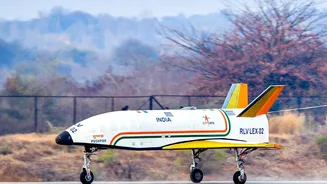
Chennai's Agnikul Cosmos is revolutionizing rocket manufacturing with its focus on 3D-printed engines. The startup, incubated at IIT Madras, builds the Agnibaan family of rockets, designed for launching small satellites weighing up to 300 kg. Its Agnilet engine is the world's first single-piece 3D-printed engine, a technology that drastically cuts down manufacturing time and complexity. Agnikul achieved a key success with the launch of its sub-orbital technology demonstrator, 'SOrTeD', from India's first privately-built launchpad. The company is now expanding its facilities in Chennai to develop reusable launch vehicle technology, a move that would place it in an elite group of companies globally aiming to make space access more sustainable and cost-effective. Recent funding will support these efforts, including a new integrated space campus in Tamil Nadu.
Pixxel: A Hyperspectral Eye on Earth
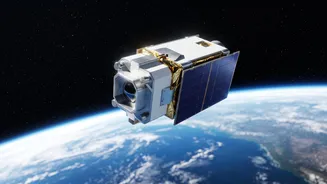
While some startups focus on getting to space, Pixxel is dedicated to observing Earth from it. The company is building a constellation of the world's highest-resolution hyperspectral imaging satellites. Unlike standard cameras, hyperspectral imagers capture light across hundreds of specific wavelengths, revealing data invisible to the naked eye. This technology has profound applications for Earth, from detecting crop diseases and improving agricultural yields to monitoring illegal mining, tracking pollution, and analyzing climate change effects. After launching technology demonstration satellites named 'Shakuntala' and 'Anand', Pixxel deployed the first satellites of its commercial 'Firefly' constellation in 2025. The company aims to provide global coverage with a rapid revisit time, delivering AI-powered insights to clients like the Indian Ministry of Agriculture and major global corporations.
Dhruva Space: Full-Stack Satellite Solutions
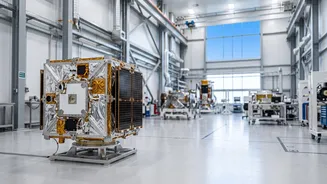
Dhruva Space offers end-to-end space engineering solutions, positioning itself as a one-stop shop for building, launching, and operating satellites. The Hyderabad-based company provides a range of products, including modular satellite platforms for various weight classes, satellite orbital deployers, and ground station services. Their deployers have been successfully space-qualified on ISRO's PSLV missions. Dhruva Space is increasingly involved in strategic projects, recently signing a significant contract with France's Safran Space to supply critical systems for a 52-satellite surveillance constellation. This highlights a major shift toward integrating private Indian companies into national security and strategic space infrastructure, moving beyond bespoke builds to a repeatable, manufacturing-ready model for satellite deployment.
Bellatrix Aerospace: Greener, Faster Propulsion
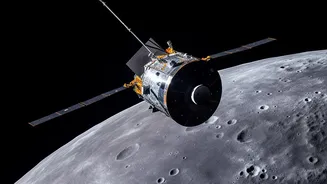
At the heart of every satellite's journey is its propulsion system, and Bengaluru's Bellatrix Aerospace is a key innovator in this domain. The company specializes in developing advanced in-space propulsion systems, including eco-friendly 'green' propellants and high-efficiency electric thrusters. These systems help satellites maneuver in orbit more efficiently, extending their operational life and reducing mission costs. Bellatrix has successfully tested its thrusters in space on ISRO's POEM missions. Looking ahead, the company is developing 'Project 200', an ambitious plan to build a satellite that can operate in an ultra-low Earth orbit (below 250 km). Operating at this altitude, which is challenging due to atmospheric drag, would dramatically improve image resolution and reduce communication latency, opening up new possibilities for Earth observation and telecommunications.