







What is a Cosmic Lighthouse?
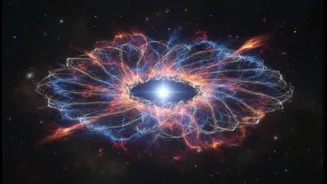
Deep in space, about 1,000 light-years from Earth, lies an object known as a pulsar. Pulsars are the super-dense, collapsed cores of massive stars that have exploded in a supernova. Though only about the size of a city, they pack more mass than our sun
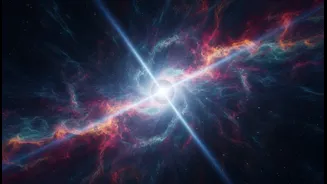
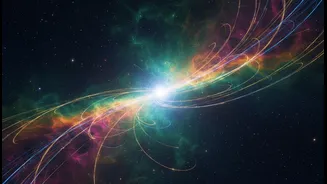
and spin at incredible speeds. The Vela pulsar, the subject of this new map, rotates 11 times every second. As they spin, their intense magnetic fields create powerful beams of radiation that shoot out from their poles. If these beams happen to sweep past Earth, we see a regular pulse of energy, much like a sailor at sea sees the rotating beam of a lighthouse. This gives them their name: 'pulsating stars', or pulsars. The area around them, filled with energetic particles, is called a pulsar wind nebula.
NASA's New 'Polarized Glasses'
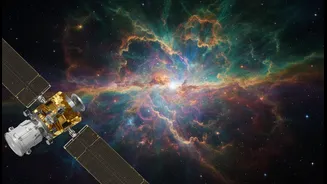
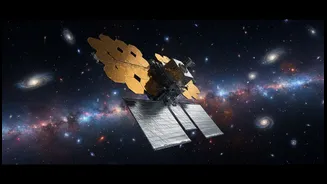
For decades, we’ve studied objects like pulsars by looking at the intensity and energy of their light. But NASA's Imaging X-ray Polarimetry Explorer (IXPE) satellite gives us a new way to see. Launched in 2021, IXPE is the first telescope dedicated to measuring the polarization of X-rays from cosmic sources. Polarization is the direction in which light waves are oriented. Think of it like wearing a pair of polarized sunglasses to cut down glare; the glasses work by blocking light waves that are oriented in a certain direction. IXPE does something similar for X-rays. By measuring this orientation, scientists can deduce the structure and direction of the magnetic fields where the X-rays originated, something that was previously impossible to see directly. This gives us an entirely new layer of information about the universe's most extreme objects.
Mapping the Lighthouse Nebula
IXPE recently spent 18 days staring at a pulsar known as PSR J1101-6101, located in the so-called 'Lighthouse Nebula'. The goal was to map the magnetic field of the nebula, which is shaped by the pulsar's wind of high-energy particles colliding with interstellar gas. Scientists were particularly interested in a long, thin 'filament' of particles extending away from the pulsar. By measuring the X-ray polarization, IXPE confirmed with over 99% confidence that the magnetic field runs parallel to this filament. However, the map also came with a huge surprise: the degree of polarization was unexpectedly high. This suggests the magnetic field is remarkably uniform and orderly, not the turbulent, chaotic mess many theories predicted. It’s like finding a perfectly straight and calm highway where you expected a tangled mess of backroads.
Why This Pulsar Map Matters
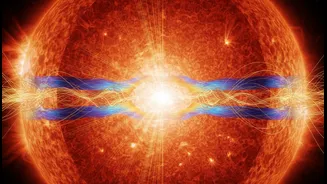
This map is more than just a pretty picture; it's a unique laboratory for extreme physics. Pulsars are natural particle accelerators, flinging matter to near the speed of light—a process we can't replicate on Earth. Understanding how they do this is a fundamental question in astrophysics. The high level of order in the magnetic field challenges existing models that rely on turbulence to explain how particles get accelerated. The findings suggest a different, more efficient process might be at play, such as magnetic reconnection, where magnetic field lines break and re-join, converting magnetic energy into particle energy. This discovery forces scientists back to the drawing board to refine their understanding of how these cosmic engines work and how they pour energy into their surroundings.
New Questions and Future Discoveries
The IXPE map also revealed another puzzle. While the X-ray data showed a magnetic field running parallel to the pulsar's trail, radio observations of the same area show a magnetic field pointing in a completely different, almost perpendicular, direction. This stunning divergence suggests that particles of different energies are behaving differently and are shaped by distinct magnetic structures within the same nebula. It hints at multiple, complex acceleration mechanisms working at once. What we learn from the Lighthouse Nebula can be applied to other mysterious and powerful objects in the universe, like the regions around supermassive black holes. Each new map from IXPE isn't just an answer, but a new set of thrilling questions that will guide the next wave of cosmic exploration.