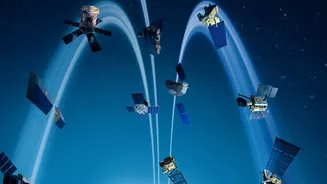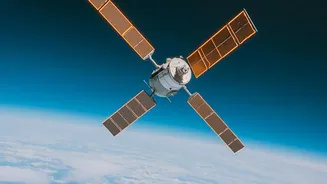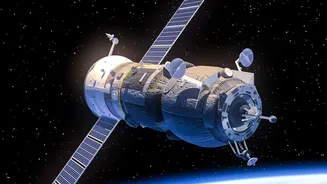






It sounds like a contradiction: to stay in the sky, a spacecraft must constantly fall. Yet, that's exactly what an orbit is—a state of continuous free-fall. The secret ingredient that prevents a fiery crash is achieving a precise speed.
The Cannon on the Mountaintop
The easiest way
to understand orbit is with a classic thought experiment first imagined by Isaac Newton. Picture a cannon on top of a mountain so tall it pokes out above Earth's atmosphere. If you fire a cannonball with a small amount of gunpowder, it travels a short distance before gravity pulls it to the ground. Now, if you add more gunpowder, the cannonball flies faster and farther before it lands. Its path curves, but it eventually intersects with the Earth. But what if you could fire it so fast that as it falls, the Earth's surface curves away from it at the exact same rate? The cannonball would still be falling, but it would never get any closer to the ground. It would endlessly circle the planet. That is an orbit. It is not about escaping gravity, but about having enough sideways velocity to continuously 'miss' the ground as you fall.
The Perfect Sideways Speed
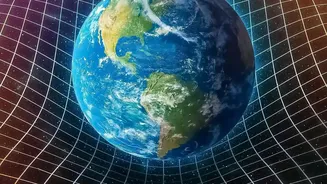
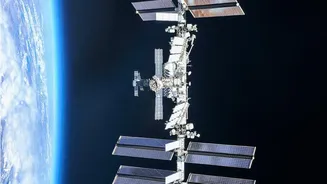
This 'just right' speed is called orbital velocity. For a stable, relatively circular path just above the atmosphere in what's known as Low Earth Orbit (LEO), that speed is a staggering 17,500 miles per hour, or about 7.8 kilometers per second. At this velocity, the pull of Earth's gravity provides the exact amount of force needed to bend the spacecraft's straight-line trajectory into a closed loop around the planet. Think of it as a perfect balance. Inertia makes the object want to fly off into space in a straight line, while gravity is constantly pulling it back down. When these two forces are in harmony, the result is a stable orbit, the very state of 'falling around Earth continuously'.
The Danger of Getting it Wrong
Achieving this speed is where the 'crucial' part of orbital insertion comes in. The margins for error are incredibly slim. If a spacecraft is moving too slowly, gravity wins the tug-of-war. Its path will curve too sharply downwards, causing it to re-enter the atmosphere where it will either burn up due to friction or crash back to Earth. This is known as orbital decay. On the other hand, if the spacecraft is moving too fast, its inertia will overpower Earth's gravitational pull. Instead of a closed circle or ellipse, its path will become an open-ended hyperbola, and it will fly off into deep space, never to return. This is why reaching escape velocity, which is about 25,000 mph, is necessary for missions to the Moon or Mars, but fatal for a satellite meant to circle Earth.
Not All Orbits Are Created Equal
Interestingly, the required orbital speed changes with altitude. The farther a satellite is from Earth, the weaker the planet's gravitational pull becomes. As a result, a lower velocity is needed to maintain an orbit. While LEO satellites zip around at 17,500 mph, a satellite in a geostationary orbit (GEO) about 22,223 miles up travels at a more 'leisurely' 7,000 mph. At that specific altitude and speed, its orbital period is exactly 24 hours. This means it appears to hover over a single spot on the Earth's surface, making it perfect for communications and weather satellites. Getting it there requires a complex series of engine burns to first climb to that height and then adjust its speed for that new, slower, and much higher orbital path.