





A World More Alive Than Imagined
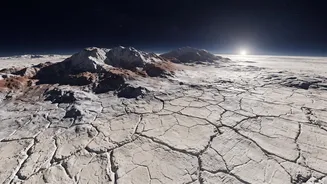
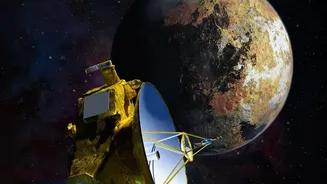
When NASA's New Horizons spacecraft flew past Pluto in 2015, it sent back images that transformed our view of the dwarf planet. Instead of a simple, cratered ice ball, we saw towering mountains of water ice, vast glaciers of frozen nitrogen, and a stunningly
complex landscape. This suggested Pluto was geologically active, a surprising trait for a world so far from the sun's warmth. Now, more than a decade later, scientists are still unearthing secrets from that data, and the latest discoveries are adding new layers to the mystery of how this distant world stays active.
Signs of Flowing Liquid Nitrogen
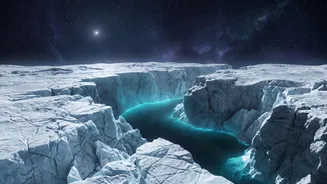
In August 2026, a team of researchers announced the first evidence of recently flowing liquid on Pluto's surface. By re-examining images of the famous heart-shaped glacier, Sputnik Planitia, scientists noticed dark features that strongly resemble patterns left by meltwater on glaciers here on Earth. Given Pluto's frigid conditions, rain is impossible, leading scientists to a stunning conclusion: liquid nitrogen may be welling up from beneath the glacier's surface through cracks, flowing temporarily before refreezing. “Pluto never stops surprising us,” said Alan Stern, the principal investigator of the New Horizons mission. The pressure from the kilometres-deep nitrogen ice at Sputnik Planitia is believed to be enough to melt the nitrogen at its base, allowing it to percolate to the surface.
City-Sized Landslides
As if flowing liquid weren't enough, another recent study published in the journal Icarus identified the first definitive evidence of massive landslides on Pluto. A team poring over high-resolution images found six distinct landslides along the inner walls of three impact craters near the western edge of Sputnik Planitia. Some of the debris fields from these events are vast, with one covering an area of 130 square kilometres—large enough to bury a small city. These landslides, which traveled for surprisingly long distances in Pluto's low gravity, are yet another sign that the dwarf planet's surface is being actively transformed by geological processes. The triggers remain a mystery but could range from tectonic activity to subsequent meteoroid impacts.
The Engine of an Icy World
So what is powering all this activity? The two big theories are residual heat and a subsurface ocean. Although far from the sun, Pluto may still retain enough heat from its formation, or from the decay of radioactive elements in its core, to keep things churning. This internal heat could be what melts the base of nitrogen glaciers and also what may be powering cryovolcanoes—or 'ice volcanoes'. Features like the towering Wright Mons have been identified as likely cryovolcanoes, which erupt a slushy mix of water, ammonia, or methane instead of molten rock. The other tantalizing possibility is a vast ocean of liquid water lurking miles beneath the ice shell. The very existence of the massive Sputnik Planitia glacier suggests there may be a denser layer of liquid water below, which helped reorient the entire dwarf planet over millennia.