


It’s amazing to think that some of the biggest secrets of our solar system are hidden in the smallest of particles. A recent NASA-supported study did just that, analysing a few microscopic grains of dust to unlock clues from its farthest reaches.
The Solar System’s Icy Attic
Beyond
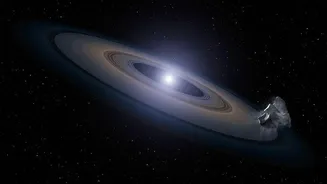
the orbit of Neptune lies a vast, doughnut-shaped region of space called the Kuiper Belt. Think of it as the solar system’s deep freeze, a place filled with millions of icy bodies that are leftovers from when the planets formed some 4.6 billion years ago. These Kuiper Belt Objects, or KBOs, range in size from small chunks of ice and rock to dwarf planets like Pluto. Because they are so far from the Sun, these objects have remained largely unchanged, preserving a pristine record of the primordial materials that built our world. Scientists study the Kuiper Belt to understand how our solar system was born and how it evolved. By looking at these ancient relics, they can piece together the story of planetary migration and the chemical makeup of the early solar system.
Catching Dust in the Stratosphere
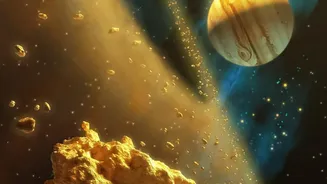
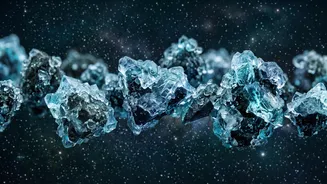
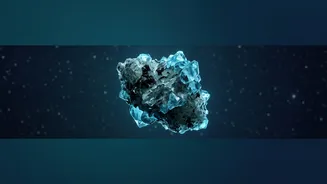
Getting a sample directly from the Kuiper Belt is incredibly difficult. But luckily for scientists, tiny bits of it come to us. As KBOs collide or are bombarded by smaller particles, they release microscopic dust grains. Some of this dust drifts inward toward the Sun and eventually reaches Earth. A recent study, published in the journal Science Advances, focused on just 12 of these interplanetary dust particles collected from Earth's stratosphere. The key was proving their origin. As these grains travelled through space, they were exposed to solar energetic particles that left tiny scars, or 'tracks', in their crystalline structure. The high density of these tracks confirmed the grains had spent a very long time travelling, pointing to an origin in the distant Kuiper Belt.
Heavy Water and Primordial Clues
Though the sample size was just a dozen grains, the findings were profound. Analysis showed the dust was primarily made of hydrated minerals, meaning they had reacted with water in the past. But this wasn't just any water. By studying the isotopic composition of the minerals, researchers determined that the water involved was rich in 'heavy oxygen', a stable, non-radioactive isotope of the element. This provides the first compelling physical evidence for a long-theorised reservoir of heavy water in the outer solar system. It suggests that the water and other materials in the Kuiper Belt were largely isolated from the materials that formed the inner planets, preserving a distinct chemical signature from the dawn of the solar system.
More Than Just a Few Grains of Dust
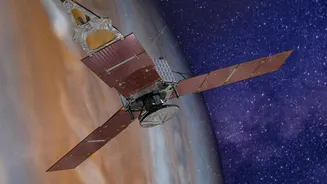
This discovery, based on a tiny sample, has big implications. It gives modelers of planet formation a new chemical blueprint to work with. One theory is that the gravity of the giant planets, like Jupiter and Saturn, acted as a barrier, preventing much of the outer solar system's material from mixing with the inner solar system's. This finding supports that idea. Furthermore, these tiny dust grains help us understand data from missions like New Horizons. That spacecraft's dust counter found higher-than-expected levels of dust far out in the Kuiper Belt, suggesting the belt might be larger or contain more material than previously thought. The analysis of grains that reach Earth helps put these remote measurements into a chemical context, confirming that this distant region is a dynamic and scientifically rich frontier.
A Window into the Past
Every dust grain that makes the billion-mile journey from the Kuiper Belt to Earth is a microscopic time capsule. The flyby of KBO Arrokoth by the New Horizons spacecraft in 2019 revealed a primordial world that had been gently assembled and perfectly preserved for billions of years. The dust from objects like Arrokoth carries the same pristine information. By studying its composition—from silicates to frozen methanol and unique water isotopes—we get a direct look at the cold, dusty cloud of material from which everything in our solar system, including Earth itself, was born. These small particles answer big questions about where we came from and whether the processes that shaped our solar system are common throughout the galaxy.