


The Visitor From Beyond
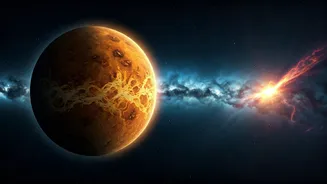
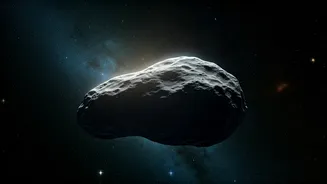
In 2017, astronomers detected something unprecedented. An object, later named ‘Oumuamua (Hawaiian for ‘scout’), was spotted tumbling through our solar system. This wasn't just another asteroid or comet. Based on its trajectory, scientists confirmed it came
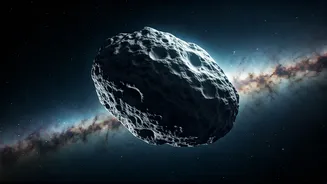
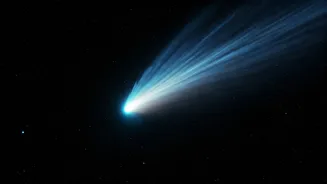
from interstellar space — the vast emptiness between stars. It was the first object of its kind ever observed. But its origin wasn't the only strange thing. ‘Oumuamua was highly elongated, perhaps like a cigar or a flat pancake, unlike the lumpy rocks we’re used to. Most puzzling of all, after slingshotting around the Sun, it sped up, pushing away as if propelled by an engine. Yet, there was no visible evidence of this propulsion. Comets speed up when ice on their surface turns to gas, creating a visible tail or 'coma'. ‘Oumuamua had no such tail.
A 'Lightsail' from Another World?
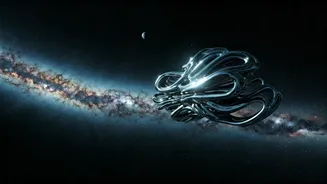
The lack of a simple explanation for this acceleration left a door open for a more extraordinary idea. Harvard astronomer Avi Loeb famously proposed that ‘Oumuamua could be an artificial object — a piece of alien technology. His leading hypothesis was that it might be a 'lightsail,' a thin craft designed to be pushed by stellar radiation, similar to concepts we have on Earth. It wasn't just a wild guess; it was a hypothesis born from the fact that known natural phenomena didn't quite fit the data. The idea was provocative and captured the public imagination. For the first time, a serious scientist was arguing that we might have just witnessed an alien probe. The debate was on: was it nature, or was it nurture from another civilisation?
Science Searches for a Natural Cause
In science, an extraordinary claim requires extraordinary evidence. While the alien tech theory was exciting, the scientific community got to work trying to find a natural explanation that fit all the facts. This is the heart of the scientific method: test every plausible, and even seemingly implausible, natural cause before resorting to aliens. Several theories were proposed. Could it be a 'nitrogen iceberg' chipped off a Pluto-like planet in another star system? That could explain the acceleration without a visible tail, but such an object would likely have evaporated much faster. Another idea was that it was a 'hydrogen iceberg,' but those are not thought to form naturally. Each new theory was scrutinised, debated, and tested against the observational data. The mystery deepened, but the process was working.
The Leading Explanation Emerges
Recently, a compelling and purely natural explanation has gained significant traction. Research by scientists Jennifer Bergner and Darryl Seligman suggests that ‘Oumuamua was likely a water-rich comet fragment. Their model shows that as an object like this passes through interstellar space, the intense radiation can knock hydrogen atoms out of its water ice, trapping them inside the object’s structure. When ‘Oumuamua neared our Sun, the gentle heating would have been enough to release this trapped hydrogen gas. This outgassing would act like a subtle, invisible rocket engine, causing the exact acceleration observed without producing the dust and water vapour that creates a visible comet tail. This 'hydrogen outgassing' theory elegantly solves the central puzzle without needing to invoke alien engineers.
So, What is 3I/ATLAS?
The headline's '3I/ATLAS' points to the future. '1I' was the designation for the first interstellar object (‘Oumuamua). '2I' was for Borisov, a more conventional-looking interstellar comet discovered in 2019 by the Asteroid Terrestrial-impact Last Alert System (ATLAS). '3I' will be the name given to the *third* such object we find, and powerful survey systems like ATLAS are our best bet for spotting it. While ‘Oumuamua’s alien allure has faded, each new interstellar visitor gives us a piece of another star system to study. We are getting better at finding them and, as the ‘Oumuamua story shows, better at explaining them with rigorous science. The alien theory has become less likely not because it's impossible, but because our understanding of the universe's natural wonders has grown.