

The Moon's Frozen Reservoirs
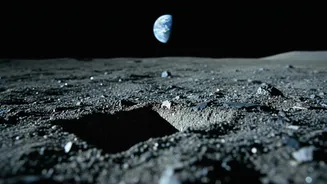
For decades, the idea of water on the Moon was the stuff of science fiction. Today, it is an established fact, crucial for humanity’s ambitions of building lunar bases and venturing deeper into space. This water isn't in lakes or oceans, but exists as ice,
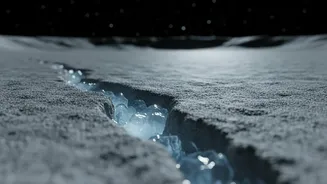
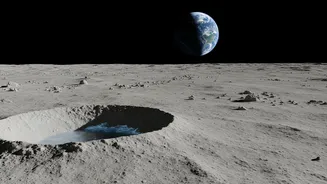
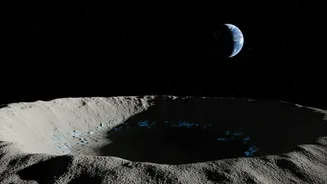
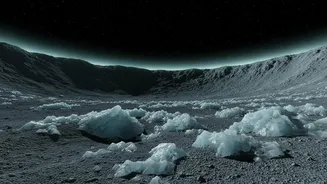
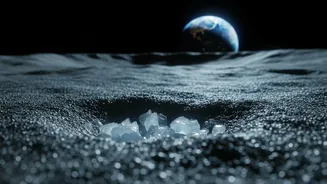
primarily trapped in Permanently Shadowed Regions (PSRs) near the lunar poles. These are craters and depressions whose floors have not seen direct sunlight for billions of years. Because the Moon’s axial tilt is a mere 1.5 degrees, these areas remain locked in a deep freeze, with temperatures plummeting to as low as -250°C. These frigid conditions act as 'cold traps', preserving ice delivered by comets, asteroids, or created by solar wind interacting with lunar soil. Understanding the exact nature and amount of this ice is a top priority for space agencies worldwide.
ISRO's Crucial Contribution
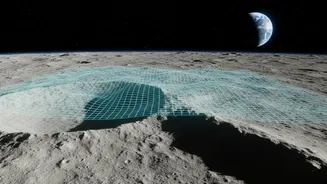
India’s space agency, ISRO, has been at the forefront of this quest. The nation's first lunar mission, Chandrayaan-1, carried a NASA instrument that provided definitive proof of water on the Moon in 2009. More recently, data from the Chandrayaan-2 orbiter, which is still actively studying the Moon, has provided even deeper insights. A study by scientists at ISRO’s Space Applications Centre (SAC), in collaboration with several Indian and international institutions, has painted a much clearer picture of these polar ice deposits. Using data from instruments like Chandrayaan-2's Dual-frequency Synthetic Aperture Radar (DFSAR), researchers can now peer beneath the lunar surface to understand not just where the ice is, but how it's stored.
More Ice Than We Thought
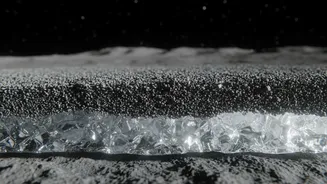
The most significant finding from this recent ISRO-led research is the sheer volume of subsurface ice. The study suggests that the amount of ice buried within the first couple of metres of lunar soil is five to eight times greater than the ice found on the immediate surface. This is a game-changer. While surface ice is easier to access, it is more vulnerable to the harsh lunar environment. Subsurface ice, however, is better protected and far more plentiful. The study also revealed a surprising disparity between the poles: the northern polar region appears to hold twice as much water ice as the southern region. This kind of detailed mapping is vital for planning future missions, helping to identify the most promising—and resource-rich—landing sites for both robotic and human explorers.
A Volcanic Origin Story
So how did this vast underground reservoir of water get there? The study confirms a long-held hypothesis: the primary source was ancient volcanic activity. During the Moon’s Imbrian period, billions of years ago, widespread volcanism led to significant 'outgassing', releasing water vapour from the lunar interior. This vapour migrated across the surface and was captured in the frigid polar cold traps, where it froze and has remained ever since. This means the ice isn't just a surface coating but is fundamentally linked to the Moon's geological history. The research, which used advanced radar analysis to distinguish the signature of ice from that of rough, rocky terrain, strengthens the case that this buried ice is stable and has survived for geological timescales, making it a reliable resource.
Fueling Our Future on the Moon
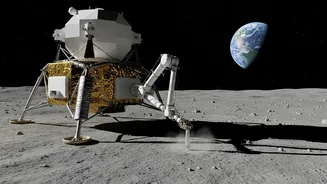
These findings have profound implications. Knowing that substantial water ice is buried just a few metres down makes the prospect of In-Situ Resource Utilisation (ISRU) far more tangible. Future astronauts could theoretically drill for this ice and extract it. Once melted, it can provide drinking water. Through electrolysis, it can be split into hydrogen and oxygen—breathable air for a lunar habitat and powerful, efficient rocket fuel for the journey back to Earth or onwards to Mars. This significantly reduces the cost and complexity of missions, as these essential resources wouldn't need to be launched from Earth. ISRO's detailed analysis provides a crucial roadmap, highlighting specific craters and regions that are prime targets for future exploration and potential resource extraction.