


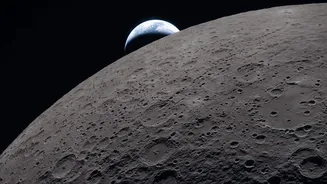
The Unforgiving Lunar Surface
Before we can build a lunar home, we have to contend with an environment far more hostile than any on Earth. The Moon has virtually no atmosphere to act as a protective blanket. This means any structure on its surface is exposed to a constant barrage
of threats. Micrometeoroids, tiny particles traveling at incredible speeds, pose a significant impact risk. Without atmospheric or magnetic shielding, the surface is also saturated with dangerous cosmic and solar radiation. Furthermore, temperatures swing wildly, from a scorching 127 degrees Celsius in sunlight to a frigid -173 degrees Celsius in the shade, creating immense engineering challenges for any surface habitat.
Nature's Potential Solution: Lava Tubes
The very volcanic activity that shaped the Moon may have also provided a solution. Scientists have long theorized the existence of lunar lava tubes—vast, underground tunnels formed by ancient flowing lava. Pits on the lunar surface, first identified by Japan's Kaguya orbiter in 2009, are believed to be 'skylights' where the roof of one of these tubes has collapsed. These subterranean caverns, if they are as extensive as believed, could offer a ready-made shelter. Protected by meters of rock, a habitat inside a lava tube would be naturally shielded from radiation, micrometeoroid strikes, and the extreme temperature fluctuations that plague the surface, making them prime real estate for a future moon base.
GIMLI: The Hunt for Hidden Caves
To move from theory to fact, NASA has selected an investigation with a fitting name: GIMLI (Geophysical Instruments for Marius Lunar pit Investigation). This mission, led by the Planetary Science Institute, will be sent to the Marius Hills Pit to determine if it is, in fact, an entrance to a larger lava tube. GIMLI isn't a rover that will drive into the cave; instead, it will use a suite of instruments from the surface to peer underground. By using radar, seismic sensors, and gravity measurements, the science team aims to map whatever lies beneath the pit and estimate the size of any hidden void. Confirming the existence of a stable, accessible lava tube would be a game-changer for the Artemis program and its long-term settlement goals.
Understanding the Lunar Environment
Finding shelter is only one part of the puzzle. As part of the same PRISM program, NASA also selected other crucial investigations. One is the Lunar Explorer Instrument for space biology Applications (LEIA). This experiment will send living yeast to the Moon's South Pole to study its biological response to the unique combination of lunar gravity and deep-space radiation. Because yeast DNA has similarities to our own, the data will help scientists understand and mitigate health risks for future astronauts. Another instrument suite, the Lunar Vulkan Imaging and Spectroscopy Explorer (Lunar-VISE), will explore the Gruithuisen Domes, a rare type of volcanic formation that could hold clues to the Moon's geologic history and potential resources.
Building the Blueprint for a Lunar Base
These investigations are not happening in a vacuum. They are foundational steps in NASA's ambitious plan, under the Artemis program, to establish a sustained human presence on the Moon. The goal is to build an Artemis Base Camp near the lunar South Pole, complete with habitats, rovers, and power systems. By using the Commercial Lunar Payload Services (CLPS) initiative, NASA is partnering with private companies like Firefly Aerospace and Intuitive Machines to deliver these scientific payloads to the surface. Each mission, from GIMLI's cave-hunting to LEIA's biological studies, provides critical data that will inform how to safely build, and live in, humanity's first off-world outpost.