



A Telescope's Momentous Gaze
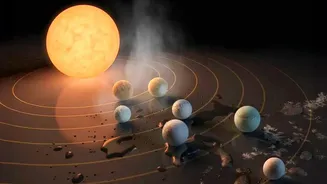
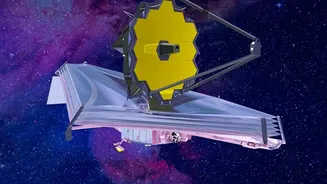
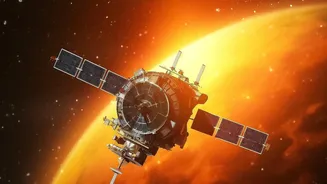
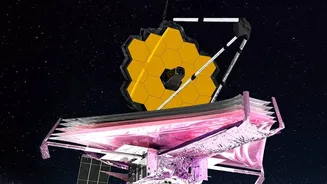
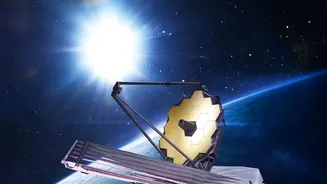
The James Webb Space Telescope, a collaboration led by NASA, has once again peered into the cosmos and returned with breathtaking new insights. Its target was the famous TRAPPIST-1 system, a compact family of seven rocky planets orbiting a small, cool
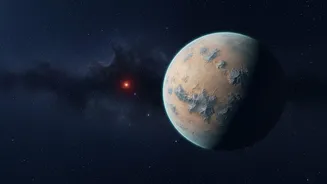
red dwarf star. Since their discovery, these worlds have been a prime location in the hunt for life beyond Earth, with at least three planets—e, f, and g—residing in the star's 'habitable zone,' where conditions might be right for liquid water. For years, scientists have used various telescopes to study this system, but the unparalleled power of the JWST has finally allowed them to analyze the faint light filtering through the atmospheres of these small, distant planets, changing our understanding of them forever.
The Chemical Signature of an Atmosphere
The big news is the definitive detection of carbon dioxide (CO2), a heavy carbon molecule, in the atmospheres of several TRAPPIST-1 planets. Scientists achieved this by using a technique called transmission spectroscopy. As a planet passes in front of its star from our point of view, a tiny fraction of the starlight shines through the planet's atmosphere. The gases in that atmosphere absorb specific colors of light, leaving a unique chemical fingerprint. For the first time, Webb's sensitive instruments picked up the unmistakable signature of CO2. This finding is crucial because it confirms that these rocky planets, unlike some of their neighbors which appear to be bare rock, possess substantial atmospheres.
Why Heavy Carbon Is a Big Deal
Finding carbon dioxide is more significant than just identifying a random gas. Planets can start with a primary atmosphere of light gases like hydrogen and helium, but these are often stripped away by the stellar wind from their host star, especially around active red dwarfs like TRAPPIST-1. The presence of a heavy gas like CO2 strongly suggests that these planets have a secondary atmosphere—one that was generated from the planet itself, likely through volcanic activity. This is a process similar to what happened on early Earth and Venus. It implies that these are not inert balls of rock, but geologically active worlds that have been able to produce and, more importantly, hold onto their atmospheric blankets over billions of years.
A System of Contrasts
The latest findings add a new layer of complexity to the TRAPPIST-1 system. Previous observations with Webb had suggested that the two innermost planets, TRAPPIST-1b and TRAPPIST-1c, have little to no atmosphere. They appear to be barren, scorched worlds. The new detection of CO2 on planets further out, such as TRAPPIST-1d and 1e, paints a picture of a diverse system where some worlds were able to retain or replenish their air while others could not. This variety in a single system provides astronomers with a perfect natural laboratory for studying how Earth-sized planets form and evolve, and what factors ultimately decide whether a planet becomes a habitable world or a sterile rock.
Not Life, But a Crucial Ingredient
It's important to be clear: carbon dioxide is not a sign of life by itself. Venus has an atmosphere that is almost entirely CO2, and it is a scorching, inhospitable world. However, the presence of a stable, long-lived atmosphere is widely considered a non-negotiable prerequisite for life as we know it. An atmosphere provides pressure to allow for liquid water on the surface, shields the planet from harmful radiation, and can help regulate temperature. By confirming that rocky, Earth-sized planets in another solar system can have substantial atmospheres, this JWST discovery represents a monumental step forward. It narrows down the search, telling astronomers that they are looking in the right kinds of places for the next big discovery: a truly habitable world.