

A Universe of Overwhelming Data
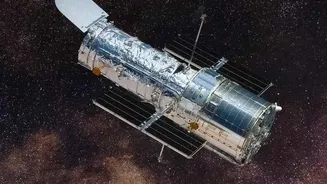
Telescopes like the Hubble and James Webb are humanity's eyes on the cosmos, capturing breathtaking images of distant galaxies and nebulae. But these instruments create a monumental challenge. The Vera Rubin Observatory, for example, is expected to generate
data equivalent to about 50,000 times the information in the Library of Congress over ten years. It is simply impossible for astronomers to manually sift through this flood of information. For decades, countless potential discoveries have been hidden in vast digital archives, waiting to be found. This is where artificial intelligence steps in, not as a replacement for human scientists, but as an essential tool to accelerate their work.
Training a Digital Astronomer
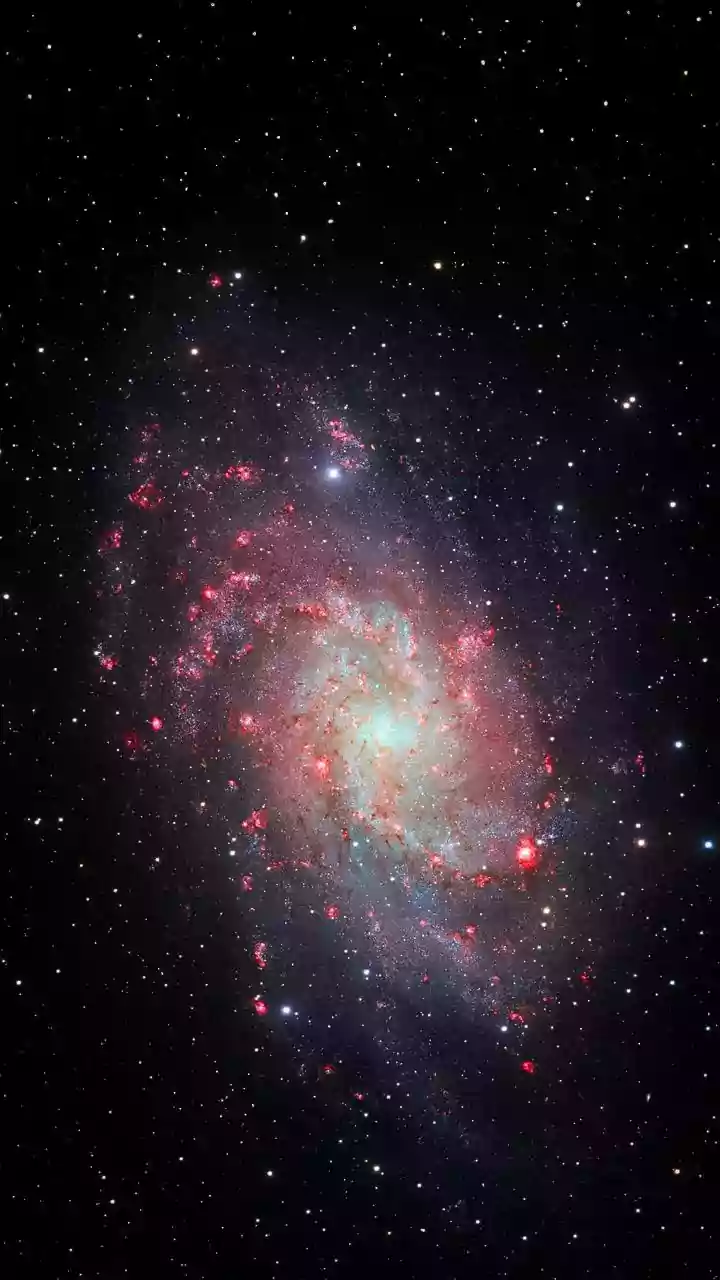
The primary type of AI used in astronomy is machine learning, particularly deep neural networks. Think of it like teaching a computer to recognise different types of animals. Scientists 'train' these AI models by feeding them millions of labelled images. For instance, they show the AI thousands of pictures of spiral galaxies and thousands of pictures of elliptical galaxies. The neural network learns to identify the distinguishing features of each, creating its own complex rules for classification. Once trained, these models can classify new, unseen galaxies with incredible speed and accuracy, sometimes reaching 98% precision. This same principle is applied to find other cosmic phenomena, such as the tell-tale dimming of a star's light that indicates a planet passing in front of it.
From Classification to Discovery
The initial use of AI was to bring order to chaos, sorting and classifying known objects. Projects like Galaxy Zoo leveraged human volunteers to classify galaxies, but AI now automates this task on a massive scale. More advanced AI models, often called convolutional neural networks (CNNs), are now used for more complex tasks. They can peer through noisy data from missions like Kepler and TESS to find potential exoplanets that human analysts might have missed. In some cases, AI has been used to sharpen images, such as the first-ever image of a black hole, by filling in gaps in the observational data based on what it learned from countless simulations.
The Hunt for Cosmic Anomalies
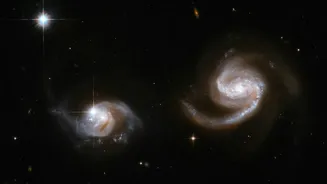
Perhaps the most exciting application of AI in astronomy is anomaly detection. Instead of telling the AI what to look for, scientists train it on what is considered 'normal' and then ask it to find anything that doesn't fit. This approach helps uncover rare, strange, and entirely new types of celestial objects. A recent project called AnomalyMatch, developed by researchers at the European Space Agency, was let loose on the Hubble archives. In just a few days, it flagged over 1,300 anomalies, including interacting galaxies, gravitational lenses, and hundreds of objects that had never been documented before. These discoveries, which would have taken humans an impossible amount of time to find, are a testament to AI's power to reveal the unexpected.
The Future Is Autonomous
The partnership between AI and astronomy is only just beginning. The next frontier involves creating autonomous systems where AI not only analyzes data but also helps decide what to observe next. Future AI-powered telescopes could potentially identify a transient event, like a supernova, and decide on its own to conduct follow-up observations without human intervention. AI is also being developed to assist with navigating spacecraft for landings on hazardous terrain, as seen with NASA's Mars missions, and to help identify geological features on other worlds. This evolution frees up human scientists from the painstaking work of data processing and allows them to focus on the bigger picture: interpreting the discoveries and asking the next great questions about our universe.