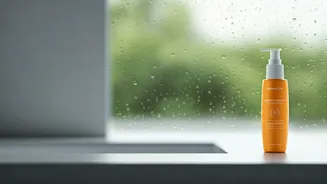








The Great Cloud Myth: Invisible Rays Don't Take a Rain Check
The biggest reason people skip sunscreen in the monsoon is the belief that clouds block the sun's harmful rays. While cloud cover does reduce visible light and the sun's heat, it doesn't stop damaging ultraviolet (UV) radiation. [27] Studies show that up
to 80% of UV rays can penetrate through cloud cover. [1, 5] In fact, certain types of partly cloudy skies can sometimes scatter and reflect radiation, which can increase the intensity of UV exposure. [2, 18] So, while you may not feel the burn, your skin is still being exposed to radiation that causes long-term damage. [5, 21]
UVA vs. UVB: The Year-Round Damage You Don't See
It's crucial to understand that there are two main types of UV rays that harm our skin. UVB rays are responsible for immediate effects like sunburn and tanning. Their intensity fluctuates with the season and weather. [26] UVA rays, on the other hand, have a longer wavelength and remain consistently potent all year round, during all daylight hours. [26] These are the rays that penetrate deep into the skin, breaking down collagen and leading to premature ageing, wrinkles, and pigmentation. [15, 21] UVA rays can pass through both clouds and window glass, meaning you're exposed even while commuting in a car or sitting near a window at home. [3, 15]
Humidity and Rain Can Make Your Skin More Vulnerable
The high humidity during the Indian monsoon can weaken the skin's natural protective barrier. [16] A compromised barrier is less effective at defending itself against environmental stressors, including UV radiation. [16] Furthermore, rain and sweat can wash away your sunscreen, leaving your skin unprotected if you don't reapply. [1] Another hidden danger is reflected UV light; wet surfaces like roads and puddles can act like mirrors, bouncing UV rays back onto your skin and increasing your total exposure. [1, 3]
How to Choose the Perfect Monsoon Sunscreen
Not all sunscreens are created equal, especially when battling humidity. For the monsoon, the ideal formula is lightweight, non-greasy, and, most importantly, water-resistant. [3, 24] Look for labels like "broad-spectrum," which means it protects against both UVA and UVB rays, and an SPF of 30 or higher. [27] Gel-based or serum-style sunscreens are excellent choices for Indian weather, as they absorb quickly without feeling sticky or clogging pores (non-comedogenic). [3, 7, 8] These formulations feel comfortable on the skin and are less likely to cause breakouts, a common concern in humid conditions. [7]
Application is Key: Making Your SPF Work for You
To get the full benefit, apply a generous amount of sunscreen about 20 to 30 minutes before you step outside. This allows the product to form a protective layer on your skin. One of the biggest mistakes people make is not reapplying. [5] Especially during the monsoon, when you might get caught in a shower or sweat more due to humidity, it's essential to reapply your sunscreen every two to three hours, or more frequently if you've been in the water or have towel-dried your skin. [21] Consistency is what delivers long-term protection and healthier skin. [4]