





Meet Shukrayaan: India's Next Planetary Chapter
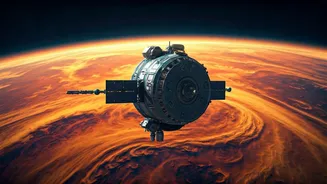
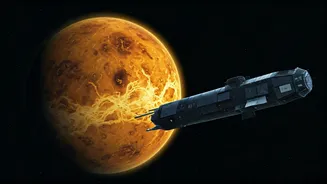
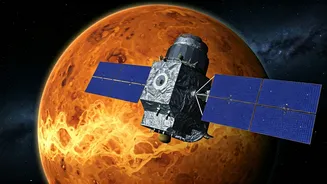
Fresh off the success of its missions to the Moon and Sun, the Indian Space Research Organisation (ISRO) is setting its sights on the brightest planet in our sky. The Venus Orbiter Mission, unofficially known as Shukrayaan-1, is India's first dedicated
mission to our planetary neighbour. Approved by the Union Cabinet, the mission is currently slated for a launch in March 2028. The primary goals are to study the planet's notoriously mysterious surface, which is hidden beneath a thick blanket of sulphuric acid clouds, and to comprehensively analyse its dense atmosphere. This ambitious project continues to cement India's position as a major player in planetary exploration.
Venus: Earth's 'Evil Twin'
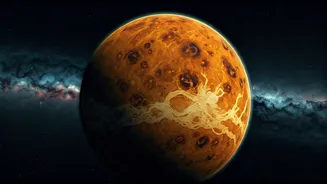
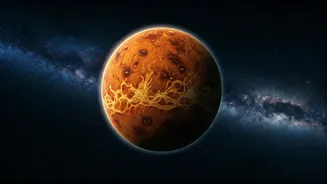
At first glance, Venus and Earth are remarkably similar. They are close in size, mass, and composition, leading scientists to call Venus our sister planet. But the similarities end there. Venus is the hottest planet in the solar system, with a surface temperature around 465°C. Its atmosphere is over 90 times denser than Earth's and composed almost entirely of carbon dioxide. Scientists believe Venus wasn't always this way. Climate models suggest it may have once hosted oceans and had a temperate climate, much like Earth. Understanding what caused this dramatic transformation from a potentially habitable world into a toxic hothouse is a key scientific question that Shukrayaan-1 will help answer.
The Runaway Greenhouse Effect
The prime suspect for Venus's climate catastrophe is a phenomenon called the 'runaway greenhouse effect'. The process likely began when Venus, being closer to the Sun, received more intense solar radiation. This would have caused its early oceans to evaporate, filling the atmosphere with water vapour—a powerful greenhouse gas. This water vapour trapped more heat, which caused more water to evaporate, creating a vicious positive feedback loop. Eventually, the oceans boiled away completely. Without oceans to absorb carbon dioxide, the gas flooded the atmosphere, leading to the extreme temperatures and pressures we see today. This process effectively turned Venus into a planetary pressure cooker.
A Natural Laboratory for Earth's Climate
Studying Venus provides scientists with a natural laboratory to understand the limits of planetary habitability. While Earth is not in immediate danger of a Venus-style runaway greenhouse effect, the processes are the same. By studying Venus's extreme climate, scientists can test and refine the climate models they use to predict Earth's future. It serves as a cautionary tale, demonstrating how dramatically a planet's climate can change. The data collected by Shukrayaan-1 on Venus's atmospheric composition, circulation, and interaction with solar wind will provide invaluable information for understanding the mechanisms that regulate climate on rocky planets like our own.
ISRO's Toolkit for a Hostile World
To peer beneath Venus's thick clouds, Shukrayaan-1 will carry a sophisticated suite of scientific instruments. A key payload is a high-resolution Synthetic Aperture Radar (SAR), which can map the planet's surface and look for signs of active volcanoes and lava flows. Other instruments, like thermal cameras and spectrometers, will study the composition and dynamics of the atmosphere, investigate the structure of the clouds, and measure the planet's interaction with the solar wind. With contributions from international partners, including Sweden, the mission's 19 payloads are designed to give us the most comprehensive picture of Venus yet.