



Sailing on Sunbeams
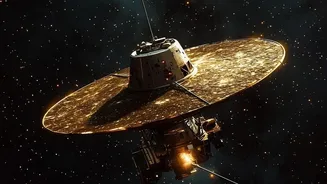
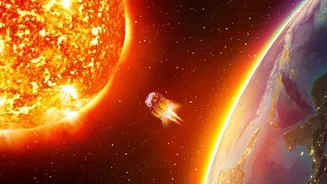
At the heart of solar sailing is a fundamental principle of physics. Sunlight is composed of particles called photons. While photons have no mass, they possess momentum. When a countless stream of these particles strikes a reflective surface, they transfer
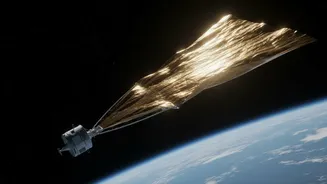
a tiny amount of momentum, exerting a constant, gentle pressure. In the friction-free vacuum of space, this minuscule push, when applied continuously over a vast, mirror-like sail, can build up incredible speeds. Unlike the solar wind, which is a stream of charged particles, this propulsion comes from light alone. This allows a spacecraft to accelerate indefinitely, as long as it is exposed to sunlight. It’s a revolutionary departure from chemical rockets, which are limited by the amount of fuel they can carry.
The Ultimate Green Propulsion
The single greatest advantage of a solar sail is its independence from propellant. Traditional spacecraft are constrained by the rocket equation; the more you want to accelerate, the more fuel you need, which adds mass, which in turn requires even more fuel to launch. Solar sails break this cycle. They use an unlimited resource that is freely available throughout the solar system: sunlight. This makes them an exceptionally low-cost and efficient propulsion system for long-duration missions. By eliminating the need for heavy propulsion systems and bulky fuel tanks, spacecraft can be made lighter, launched on smaller, cheaper rockets, and dedicate more of their mass to valuable scientific instruments.
Lighter, Stronger, Faster
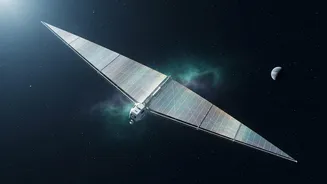
The headline-making advances are in the sails themselves. Early solar sails, though effective, faced material challenges. The ideal sail must be incredibly large to catch enough photons, yet astoundingly lightweight and durable enough to survive compact stowage, deployment, and the harsh space environment. Recent breakthroughs, like those tested in NASA’s Advanced Composite Solar Sail System (ACS3) mission, focus on new composite materials for the booms that unfurl and support the sail. These carbon-fiber-reinforced polymer booms are significantly lighter and more resistant to warping from temperature changes than previous metallic versions. This allows for the design of larger, more stable sails packed into incredibly small volumes, such as a satellite the size of a microwave oven.
A New Era of Cosmic Journeys
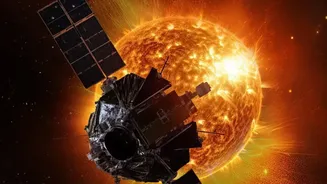
While solar sails provide gradual acceleration and aren't suited for a quick trip to Mars, they excel at missions that are difficult or impossible for conventional rockets. Their continuous thrust enables them to achieve unique orbits, such as hovering in a fixed position closer to the Sun to provide earlier warnings of solar storms. Missions like Japan's IKAROS, which flew by Venus in 2010, and The Planetary Society's LightSail 2, which successfully used sunlight to alter its orbit around Earth, have proven the technology's viability. Future concepts envision using solar sails for fast transit to the outer solar system, potentially reaching distant targets in a fraction of the time current probes take. Some researchers are even exploring how powerful lasers could one day push sails on interstellar journeys.