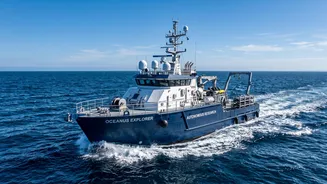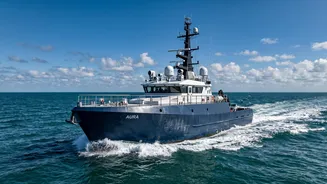




Self-driving technology is no longer just for cars. The next frontier is the high seas, but testing autonomous ships is incredibly risky. Now, IIT Madras has developed a groundbreaking solution to navigate these choppy developmental waters.
The Challenge of Unmanned Ships
Imagine a massive
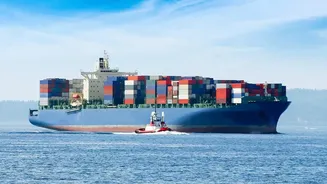
cargo vessel navigating a busy shipping lane without a human crew at the helm. This is the future of maritime logistics, promising greater efficiency and safety by removing human error from the equation. However, getting to that future is a monumental challenge. Unlike roads, the open ocean is an unpredictable environment. Real-world testing of autonomous navigation systems is fraught with peril; a single bug in the software could lead to a catastrophic collision, environmental damage, and enormous financial losses. Developing the sophisticated algorithms that allow a ship to perceive its surroundings, make decisions, and avoid obstacles requires thousands of hours of testing across countless scenarios, from calm seas to raging storms and congested ports. The sheer cost and danger of conducting these tests physically has been a major bottleneck for innovation in the sector, creating a need for a safer, more efficient alternative.
Introducing SeaNav: A Digital Ocean
Enter SeaNav, the ingenious solution developed by researchers at the Indian Institute of Technology Madras. At its core, SeaNav is a sophisticated simulation environment, often described as a 'digital twin' for marine navigation. It creates a hyper-realistic virtual replica of the maritime world where developers can test their autonomous vessels. Instead of launching a multi-million dollar prototype into a real port, engineers can upload their navigation and control software into the SeaNav platform. Here, the virtual ship can be put through its paces in a completely safe and controlled digital space. The platform allows for rapid, repeatable, and exhaustive testing that would be impossible in the real world. It’s like a flight simulator for ships, enabling endless practice runs without ever putting a real vessel, its cargo, or the marine ecosystem at risk. This ability to test, fail, and refine in a virtual environment is set to dramatically accelerate the development timeline for autonomous shipping.
Inside the Simulation
The power of SeaNav lies in its remarkable detail. The platform, developed at IIT Madras's Centre of Excellence for Autonomous and Unmanned Systems, is not just a simple video game. It incorporates complex mathematical models to simulate a wide array of real-world variables. Developers can model different types of vessels, from small survey boats to large container ships, each with its own unique handling characteristics. They can subject these virtual ships to diverse weather conditions, including varying wind speeds, wave heights, and ocean currents. Crucially, SeaNav can simulate complex traffic scenarios, populating the virtual waters with dozens of other vessels, both manned and unmanned, to test collision avoidance systems under pressure. The system provides a wealth of data and performance metrics, allowing engineers to analyse how their software performs, identify weaknesses, and continuously improve the vessel’s decision-making capabilities. This rigorous pre-verification ensures that by the time a system is ready for physical sea trials, it has already proven its ability to handle a vast range of challenges.
Why This Matters for India
The creation of SeaNav is more than just an academic achievement; it's a strategic enabler for India's maritime ambitions. With a coastline spanning over 7,500 kilometres and a heavy reliance on sea-based trade, the efficiency and safety of shipping are paramount to the nation's economy. By providing a homegrown platform for developing autonomous technology, IIT Madras is empowering Indian startups, defence organisations, and shipping companies to become leaders in this emerging field. This reduces reliance on foreign technology and fosters an ecosystem of innovation within the country, aligning with national initiatives like 'Aatmanirbhar Bharat'. The applications extend beyond commercial shipping, with significant potential for naval and coastal surveillance operations, where unmanned vessels can perform dangerous or tedious tasks. SeaNav provides the critical infrastructure needed to build, test, and deploy next-generation maritime solutions, positioning India at the forefront of a technological revolution that will reshape global trade and security.