






Kapil Dev: The Man Who Made India Believe in Pace
Before Kapil Dev, India was primarily known for its spin wizardry. Fast bowling was often seen as a secondary weapon, with Indian seamers merely taking the shine off the new ball for the spinners to take over. Then came the 'Haryana Hurricane'. Kapil Dev burst
onto the scene in 1978 not just as a fast bowler, but as a genuine, aggressive pace spearhead with the stamina to bowl long, hostile spells. His athletic action and ability to swing the ball at pace gave India a new dimension. He became the country's leading bowling attack for two decades. More than just his individual brilliance—becoming the first cricketer to score over 5,000 runs and take more than 400 Test wickets—his greatest impact was inspiring a generation. He made it possible for an Indian to be a world-class fast-bowling all-rounder, a dream that seemed distant before his arrival. His crowning achievement was leading India to the 1983 World Cup victory, a moment that transformed Indian cricket from a passion into a religion.
Sunil Gavaskar: The Master of Technique Against Terror
In an era when fast bowlers from the West Indies and Australia terrorised batsmen worldwide, Sunil Gavaskar stood as a fortress of calm and perfect technique. Facing some of the most fearsome bowlers in history without the protection of a modern helmet, Gavaskar demonstrated that courage was not about aggression, but about unflinching technical purity. He was widely admired for his technique against fast bowling, boasting a high average against the formidable West Indian pace quartet. Gavaskar didn't just survive; he thrived. By perfecting his defence and possessing an unshakeable concentration, he showed Indian batsmen how to neutralise raw pace. He became the first batsman in history to cross the 10,000-run mark in Test cricket, proving that an Indian opener could dominate the world's best through sheer skill and resilience. His legacy lies in instilling a sense of self-belief that Indian batsmen could be technically superior and mentally tougher than any opponent.
Sachin Tendulkar: The Pioneer of ODI Attack
Before 1994, One-Day International batting was often a cautious affair, focused on preserving wickets for a final flourish. Sachin Tendulkar changed that script. Asked to open the batting against New Zealand in Auckland, he smashed 82 runs off just 49 balls, an innings hailed by many as one that redefined ODI cricket. Previously a middle-order batsman, Tendulkar as an opener was a revelation. He blended aggression with consistency, showing the world that the opening overs were not just to be survived, but to be dominated. This out-of-the-box thinking became the new norm, forcing teams globally to rethink their strategies. The ODI revolution of the mid-1990s was built on the foundation of attacking opening batsmen, a trend that Tendulkar pioneered and perfected. He became the first man to score a double century in ODIs and finished with a staggering 49 centuries in the format, forever changing the role of the opener.
MS Dhoni: The Architect of the Modern Finish
While many were great finishers, MS Dhoni turned the run chase into a science. With a calm demeanor that earned him the name 'Captain Cool', Dhoni redefined the role of a finisher and a captain in limited-overs cricket. He approached seemingly impossible chases with a unique calculus, taking the game deep and backing himself to score improbable numbers in the final overs. His strategy was to absorb pressure and then launch a calculated assault when the opposition was at its most nervous. This approach was not just about his own batting; it became a philosophy. As captain, he backed young players, made unorthodox decisions that often paid off, and led India to victories in the T20 World Cup (2007), the 50-over World Cup (2011), and the Champions Trophy (2013). His leadership was less about textbook strategy and more about intuition, a style that empowered his players and kept opponents guessing.
Virat Kohli: The Man Who Made Fitness a Religion
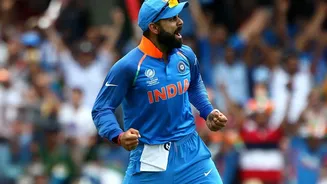
Virat Kohli’s greatest contribution to Indian cricket may well be the fitness revolution he spearheaded. Around 2012, Kohli decided that to be the best in the world, his physical condition had to be as elite as his batting technique. He transformed himself into a world-class athlete, adopting a famously strict diet and a relentless training regimen inspired by the discipline of professional footballers. This personal obsession soon became a team culture. Under his captaincy, fitness became a non-negotiable standard. The introduction of the Yo-Yo test as a selection criterion was a clear signal: to play for India, you had to be supremely fit. This shift had a tangible impact, particularly on the fast-bowling unit, which became capable of sustaining high intensity for longer periods, enabling India to compete and win in challenging overseas conditions, especially in Test cricket. Kohli made it clear that talent alone was not enough; it had to be paired with unparalleled physical discipline.