






The Paradox of Aphelion
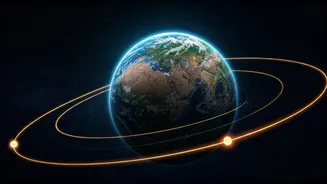
It’s a logical assumption: being farther from a heat source should make things cooler. Each year in early July, our planet reaches a point in its orbit called aphelion, swinging out to its maximum distance from the Sun. In 2026, this will happen on July 6, when
Earth will be about 94.5 million miles (or 152.1 million kilometers) from our star. This is roughly 3 million miles farther than at its closest approach, known as perihelion, which occurs in early January. Yet, for those in the Northern Hemisphere, aphelion arrives during the warmest months. This apparent contradiction is a perfect illustration that our seasons are not governed by distance.
It's All About the Tilt
The real driver of Earth's seasons is not its slightly elliptical orbit but its axial tilt. Our planet spins on an axis that is tilted by about 23.5 degrees relative to its orbital plane. Crucially, this tilt always points in the same direction in space as Earth makes its year-long journey around the Sun. When the Northern Hemisphere is tilted toward the Sun, as it is around the June solstice, the Sun's rays strike it more directly. This direct, concentrated sunlight, combined with longer daylight hours, is what produces the warmth of summer. Conversely, when that same hemisphere is tilted away from the Sun, as it is in December, the solar rays arrive at a shallower angle, spreading the energy over a wider area and resulting in the colder temperatures of winter.
The Flashlight Analogy
A simple way to visualize this is to think of a flashlight. If you shine it directly down onto a surface, you get a bright, intense, and concentrated circle of light. This is like the Sun’s energy hitting the hemisphere that is tilted towards it in summer. Now, if you angle the flashlight, the same amount of light spreads out over a much larger, dimmer, and less intense oval. This represents the sunlight reaching the hemisphere tilted away from the Sun in winter. The amount of energy hasn't changed, but its concentration has. This difference in energy concentration is far more significant for our climate than the minor change in distance from the Sun throughout the year.
Does Distance Have Any Effect?
While the axial tilt is the primary cause of seasons, the changing distance does have a few subtle effects. The sunlight reaching Earth during aphelion is about 7% less intense than at perihelion. This variation does slightly moderate the seasons. For the Northern Hemisphere, our summer at aphelion is a little milder than it would be otherwise. In the Southern Hemisphere, their summer occurs during perihelion (closer to the Sun), which should make it more intense, but this is tempered by the fact that the Southern Hemisphere is dominated by water, which heats and cools more slowly than land. In fact, because Earth moves more slowly in its orbit when it is farther from the Sun, Northern Hemisphere summers are actually the longest season, lasting nearly five days longer than winter.