









The Legend of the Seven Pagodas
The magnificent Shore Temple at Mahabalipuram, a UNESCO World Heritage site, stands as a solitary sentinel on the coast of the Bay of Bengal. But for over a thousand years, folklore and the accounts of early European travellers have spoken of more. They
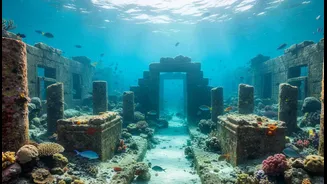
tell of the 'Seven Pagodas', a glorious city of seven temples so beautiful that the gods grew jealous and submerged six of them in a great storm, leaving only one to stand against the waves. For generations, local fishermen have passed down stories of glimpsing the glittering spires of these lost temples beneath the water on clear days. While romantic, these tales were largely dismissed as myth until the turn of the 21st century, when science began to take a serious look into the depths.
Whispers from the Deep
The first significant clues emerged in the early 2000s when joint missions by India's National Institute of Oceanography (NIO) and international partners began scanning the seabed. They discovered submerged walls, scattered dressed stone blocks, and what appeared to be the steps of a platform, all lying under several meters of water and sediment. These findings suggested a large, man-made complex from the Pallava era. Then, in December 2004, a catastrophe provided a stunning revelation. As the waters of the Indian Ocean receded just before the devastating tsunami struck, eyewitnesses reported seeing a long, straight row of large stone structures emerge from the sea before being swallowed again. The tsunami also churned the coastline, revealing previously buried sculptures, including a large stone lion, further fueling speculation.
A New High-Tech Quest Resumes
After a pause of nearly two decades, the Archaeological Survey of India's (ASI) Underwater Archaeology Wing resumed its quest in late 2025, launching a new, technologically advanced survey. This initiative builds directly on the discoveries from the early 2000s and the post-tsunami explorations. The key difference this time is the technology. The team is now equipped with a sophisticated Remotely Operated Vehicle (ROV). This underwater drone can capture high-resolution images and videos of the seabed without physically disturbing the fragile potential ruins. It allows archaeologists to explore deeper and more challenging areas with greater precision and safety, offering a non-invasive window into the past. The mission's stated goal is to solve the riddle of Mahabalipuram's submerged past, specifically focusing on structures from the 7th-8th century Pallava dynasty.
Separating Myth from Masonry
The challenge for the ASI team is immense. After centuries underwater, any man-made structures are heavily covered in thick marine growth, making them difficult to distinguish from natural rock formations. Strong underwater currents have also likely scattered the remains over a wide area. The process involves painstakingly mapping anomalies on the seafloor using sonar and then sending the ROV for a closer look. Archaeologists are looking for tell-tale signs of human activity, such as straight walls, right-angled cuts, and architectural fragments that match Pallava-era designs seen on land. Every discovery must be carefully documented and analysed to confirm its origin. It's a slow, methodical process of separating geological features from genuine archaeology.
Why This Search Matters
This survey is about more than just verifying a captivating legend. Mahabalipuram was a bustling port city and a major centre of power for the Pallava kings. Confirming the existence of a submerged complex could revolutionise our understanding of this period. It would provide invaluable information on ancient urban planning, the scale of maritime trade with regions as far as Rome and Southeast Asia, and the dramatic impact of coastal erosion and rising sea levels over the centuries. Each submerged wall and carved stone is a potential piece of a much larger puzzle, one that tells the story of a thriving civilisation and its relationship with the sea. The findings could rewrite key chapters of ancient Indian history.