


A Flood of Data From Above
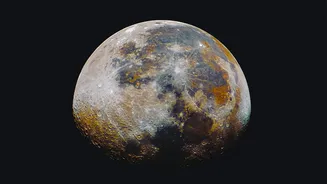
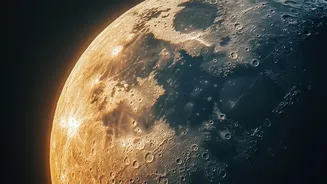
For over a decade, missions like NASA's Lunar Reconnaissance Orbiter (LRO) have been circling the Moon, capturing an unprecedented amount of high-resolution imagery. The LRO mission alone has generated more data than all other NASA planetary missions combined,
creating a detailed mosaic of the entire lunar surface. This treasure trove contains vital clues about the Moon's history and resources. But its sheer volume presents a huge challenge. Manually analyzing millions of images to count craters or identify subtle geological features is an incredibly time-consuming, painstaking process for researchers. It's like trying to find a specific grain of sand on a vast beach. This data deluge required a new approach to unlock its full potential.
Training an AI for a New World
This is where artificial intelligence comes in. In a collaboration, NASA and IBM have developed a new tool: a 'foundation model' specifically designed for lunar science. Unlike older AI models built for a single task, this foundation model was pre-trained on a massive, unified dataset. Researchers combined over 30 layers of data from nine different instruments across four missions, including imagery, topographical maps, and gravity readings. By training the AI on this rich, multi-layered information, it learns to see the Moon in a more holistic way, identifying patterns across different types of data that would be difficult for a human to spot in isolation. This open-source model is now publicly available, allowing scientists worldwide to adapt it for various research tasks.
Mapping Craters to Ensure Safe Landings
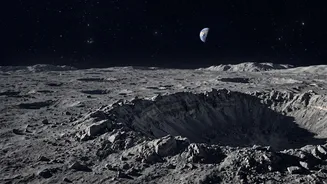
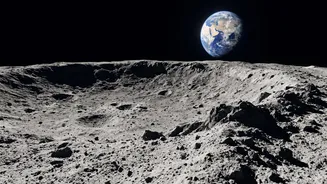
One of the AI's most critical jobs is mapping lunar craters. Every crater tells a story about the history of our solar system, and their density helps scientists date the surface. More pressingly, having a detailed map of craters, big and small, is essential for planning safe landing sites for future missions like Artemis. The Moon's surface is a minefield of hazards, and the AI can rapidly identify these obstacles much more efficiently than manual methods. In tests, these AI tools have successfully identified thousands of previously uncatalogued craters, giving mission planners a much clearer picture of the terrain that awaits future astronauts and robotic landers.
The Hunt for Hidden Water Ice
Perhaps the most exciting application of this AI is the search for water ice. Scientists have long theorized that ice could exist in the Moon's permanently shadowed regions (PSRs), especially near the poles, where temperatures are low enough to preserve it for billions of years. These areas are, by definition, incredibly dark, making them difficult to study. The new AI model excels at this task. It analyzes multiple data streams to estimate where ice is most likely to be stable, both on and below the surface. Finding these deposits is a primary goal of lunar exploration, as water can be used for drinking, creating breathable oxygen, and even being split into hydrogen and oxygen to produce rocket fuel.
Accelerating the Future of Exploration
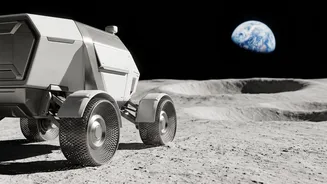
By automating the heavy lifting of data analysis, AI is not replacing scientists but empowering them. It frees them up to focus on interpreting findings and piecing together the larger story of the Moon's evolution. The NASA-IBM model has also proven adept at spotting other geological features, like unusual volcanic formations that challenge our understanding of the Moon's past. For programs like Artemis, which aim to establish a sustained human presence on the Moon, these tools are invaluable. They accelerate the process of finding resources, assessing risks, and selecting scientifically interesting locations, bringing the goal of long-term lunar settlement a significant step closer.