




India's Eye on the Sun
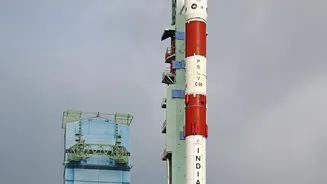
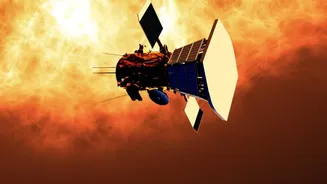
Launched in September 2023, the Aditya-L1 mission marked a major milestone for the Indian Space Research Organisation (ISRO) and the nation. Positioned at a unique vantage point 1.5 million kilometres from Earth, known as Lagrange Point 1 (L1), the spacecraft
has an uninterrupted, 24/7 view of our star. Its primary goal is to observe the Sun's atmosphere—the chromosphere and the corona—and study the dynamics of space weather. This mission is not just about scientific curiosity; it’s about moving India from being a user of solar data to a key producer, enhancing our self-reliance in space-weather forecasting.
Decoding the Sun's Fury
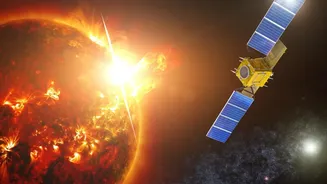
The Sun frequently unleashes colossal explosions of plasma and magnetic fields called Coronal Mass Ejections (CMEs), or solar storms. These events can hurl billions of tonnes of solar material into space at incredible speeds. If a CME is aimed at Earth, it can trigger a geomagnetic storm, posing a significant threat to our modern, technology-dependent civilisation. Such storms can disrupt communication networks, damage satellites in orbit, knock out power grids, and endanger astronauts. Understanding what triggers these storms and how they accelerate is one of the biggest challenges in solar physics, and it is crucial for protecting our vital infrastructure.
A Breakthrough in Observation
Recent data from Aditya-L1's instruments, particularly the Visible Emission Line Coronagraph (VELC) and the High Energy L1 Orbiting X-ray Spectrometer (HEL1OS), have provided stunning new insights. In one significant observation of a CME, scientists were able to capture spectroscopic data of the event's very beginning, or 'onset phase,' closer to the Sun's surface than ever before. These observations helped reveal that the temperature and turbulence in the area increased significantly during the eruption. Another study using VELC data from an energetic CME on August 5, 2024, has shed light on the long-standing mystery of why the Sun's corona is millions of degrees hotter than its surface. The findings suggest that the constant reconfiguration of the Sun's magnetic fields, a process called magnetic reconnection, supplies about 93% of the energy needed to keep the corona at its extreme temperature.
From Data to Defence
These new findings are more than just academic. A deeper understanding of the initial phases of solar flares and CMEs is a critical step toward improving our space weather prediction models. By analysing the earliest moments of a solar eruption, scientists can better forecast its trajectory and intensity. This could extend the early warning time for potentially hazardous storms from minutes to hours, giving satellite operators, power grid managers, and airlines more time to take protective measures. For instance, Aditya-L1's data on the turbulent region of a solar storm that hit Earth in October 2024 revealed how it severely compressed our planet's magnetic shield, briefly exposing some satellites to harsh conditions. This highlights the direct, practical value of the mission in safeguarding our critical assets in space and on the ground.
A Triumph for Indian Science
The success of Aditya-L1 and the groundbreaking papers being published based on its data represent a major achievement for India's scientific community. The mission has firmly established ISRO as a key player in global solar research, alongside agencies like NASA and the European Space Agency. To maximise the scientific return, ISRO has made over 27 terabytes of solar data publicly available, inviting researchers from India and around the world to analyse it. This collaborative approach is not only accelerating our understanding of the Sun but also inspiring a new generation of scientists and engineers in the country. Each new discovery reinforces India's growing capabilities in space exploration and its commitment to using science for the betterment of humanity.