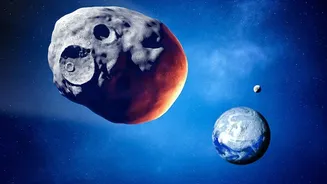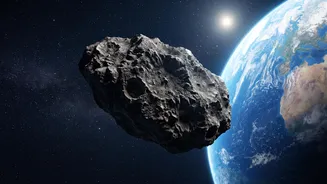



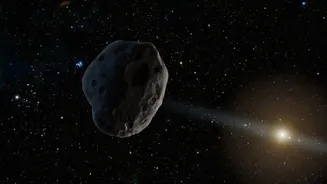
For the past several months, Earth has had a secret companion: a tiny, temporary 'mini-moon' named 2026 QQ8. But this cosmic visitor is about to say goodbye. Its brief stint orbiting our planet is coming to an end in December.
What Exactly Is a Mini-Moon?
The term 'mini-moon' might
sound like something from a sci-fi novel, but it describes a very real phenomenon. It's not an official astronomical designation, but rather a nickname for a small asteroid that gets temporarily snared by Earth's gravity. These objects, often just a few meters across, are pulled from their own orbits around the Sun and end up circling our planet for a short time—anywhere from a few weeks to several months or even years. Unlike our large, permanent Moon, their orbits are often chaotic and unstable, thanks to the complex gravitational tug-of-war between the Earth, the Sun, and our main Moon. Eventually, the Sun's stronger gravity wins out, and the mini-moon is flung back into space to continue its journey around the star.
The Brief Story of 2026 QQ8
The story of 2026 QQ8 is a perfect example of this fleeting relationship. This particular asteroid, estimated to be about two meters (or six feet) in diameter, was captured by Earth's gravity back in April 2026. However, it wasn't actually spotted until August by Hungarian astronomer Krisztián Sárneczky. At first, astronomers weren't sure what it was; its small size and dimness made it difficult to distinguish from a piece of old satellite or rocket debris. But after weeks of follow-up observations, the International Astronomical Union's Minor Planet Center confirmed it was a natural object and gave it the official name 2026 QQ8 in late October. It poses no threat to our planet and would simply burn up in the atmosphere if it ever came too close.
An Unstable, Looping Dance
A mini-moon's orbit is nothing like the tidy, near-circular path of our main Moon. Instead, objects like 2026 QQ8 follow wild, looping, spaghetti-like trajectories. They are captured when they pass through a region of space called the 'Hill sphere', where a planet's gravity dominates over the Sun's. For an asteroid to be captured, it needs to enter this zone at just the right speed and angle. These conditions are rare, but simulations suggest that at any given time, there is likely at least one object a meter or so in size temporarily orbiting Earth. The problem is finding them. Their small size and speed make them incredibly difficult for current survey telescopes to detect.
Why Our Visitor Is Leaving
The same gravitational forces that welcome a mini-moon are also responsible for showing it the door. The capture is never permanent. For 2026 QQ8, its looping orbit will soon carry it to a point where the Sun's gravitational pull becomes overwhelming. Sometime in early December, the asteroid will break free from Earth's influence and be ejected back into its own independent orbit around the Sun. This is the inevitable fate of all mini-moons. Previous confirmed visitors, like 2006 RH120 and 2020 CD3, followed similar paths, staying for about a year and three years respectively before departing. While some reports suggest the departure could be as late as January 2027, the consensus points to its exit from Earth's vicinity beginning in December.
What We Learn from Fleeting Friends
While they may be small and temporary, mini-moons are scientifically valuable. Most of these asteroids originate from the main asteroid belt between Mars and Jupiter and are considered pristine remnants from the formation of our solar system. Studying them offers a chance to analyse material from deep space without launching an expensive mission. Some astronomers even speculate that past mini-moons could have been chunks of our own Moon, blasted into space by ancient impacts. The detection of 2026 QQ8 and others like it helps scientists refine their understanding of the near-Earth object population and the complex dynamics of our solar system. As telescope technology improves, we can expect to find many more of these temporary companions, each with its own story to tell.